If you are an executive or business owner launching a digital product today, relying only on manual testing just isn’t going to work long-term. Let’s face it: it’s too slow, people make mistakes, and it gets way too expensive as you try to scale up. That’s why understanding the different types of automated software testing is now a crucial business strategy.
When you implement the right types of automation testing, QA stops being a roadblock and starts helping you beat the competition. It means you get to market faster, release updates when you say you will, and keep your customers happy.
But automation isn’t just one giant switch you flip; it’s more like a diverse tool belt with specialized tools for different jobs. If you want to fix your development process and maximize ROI, you should know what types of testing can be automated and exactly how to deploy different types of automation testing to get the best results.
In this article, you will find a C-suite guide to the key types of automated testing, their strategic value for business, and the frameworks that support them.
Before diving into the specific testing automation types, we must define the core concept.
Automated testing is the practice of using specialized software tools to control the execution of tests and compare actual outcomes with predicted outcomes.
So, it automates repetitive but necessary tasks that are difficult to perform manually.
The global market for DevOps, of which test automation is a pillar, continues to grow substantially, driven by the need for continuous delivery.
For decision-makers, the strategic value of test automation lies in 3 areas:
To achieve these benefits, companies often partner with an expert software testing company to get specialized test automation services without the overhead of in-house hiring.
A common mistake is trying to automate everything. A successful test automation strategy requires a balanced approach, building automation where it gives the highest return.
The best candidates for automation are tests that are:
For example, automating regression testing is almost always the highest priority for businesses scaling their digital products.
Manual testing is key for scenarios requiring human judgment, empathy, and creativity. You should not try to automate:
By balancing automation with strategic manual software testing, you will achieve comprehensive quality coverage.
The spectrum of testing automation types is really vast. To provide clarity, we classify types of automation testing into functional, non-functional, and specialist categories.
Understanding these different types of automation testing and using the right one is crucial for building a resilient product.
Functional testing validates what the system does against the business requirements. These constitute the bulk of the types of testing in automation testing.
Think of Unit Testing as testing the very smallest “units” of your code — like individual bricks in a wall — to make sure none of them are cracked.
They isolate and test single functions, classes, or components in absolute isolation. Because they are checking only tiny pieces of code, they are highly technical, extremely fast (running in milliseconds), and are usually written and maintained by your developers, not the QA team. They constitute the largest part of any modern type of automation testing framework.
For instance, you are building an e-commerce platform. A developer writes a function to “calculate sales tax.” A Unit Test checks only that function. It inputs a price of €100 and a tax rate of 21% and validates that the function returns exactly €121. It doesn’t check the database, the UI, or the user profile. It just checks that the math in that one function is perfect.
Your software’s components might all pass their individual Unit Tests perfectly. But the worst bugs often happen when you try to connect them. Integration Testing verifies the interactions between these combined units.
When you use test automation strategy guidelines to build your QA pipeline, integration testing is crucial. It ensures that data flows correctly between different modules, APIs, and databases.
Keeping to our example, on your e-commerce platform, you have a “User Profile” module and a “Payment Gateway” module. Integration testing doesn’t just check that you can log in or that you can enter a credit card. It checks that after you log in, the “User Profile” correctly communicates your saved delivery address to the “Payment Gateway” to calculate the final shipping cost. If the data is lost or corrupted in transit, this test will fail.
API stands for Application Programming Interface. In simpler terms, APIs are the “plugs and sockets” that let different pieces of software talk to each other. Nearly every modern digital service relies heavily on them. In 2026, investing in API security testing automation and functional validation is mandatory.
Here is the best part: testing at the API layer, rather than the graphical user interface (GUI), is much faster, far more stable, and easier to automate. Because you are testing the logic directly, you get results in seconds rather than minutes. It is one of the highest-ROI types of testing automation you can choose.
Almost every European digital service integrates external APIs. For example, if your platform has an “Address Verification” feature, it might call an external API like Google Maps or a national postal service. An automated API test doesn’t open a browser. Instead, it sends a standardized “query” to the postal API containing a specific address like “Karlstrasse 10, Berlin” and validates that the API sends back a clean, verified, structured response within 500 milliseconds, checking that the service is both correct and fast.
Both of these are types of automated software testing that function as “gatekeepers.” They are a crucial subset of your automation testing types that run very early in the development lifecycle.
Smoke Testing is a broad but shallow check of the entire build. Think of it as a “startup check” for your application. We use it to ensure the critical functionalities — the parts that have to work or there is no point in continuing — are at least responding.
The term comes from hardware, where you just turn a device on to see if any smoke comes out. In mobile QA, this means just ensuring the app opens and doesn’t crash on launch. If the smoke test fails, the build is rejected, and your developers are notified immediately, saving manual software testing time.
A smoke test example for e-commerce can be like this:
Sanity Testing is narrower. We run this after a bug fix or a minor code change. While a Smoke Test checks everything superficially, a Sanity Test dives deep into one specific area. Its goal is just to ensure that the developer actually fixed the reported bug, and that nothing else in that narrow module was immediately broken by the fix. It’s a crucial type for mobile app testing when trying to release rapid patches.
A sanity test example for e-commerce can be like:
Users reported a bug like “The 10% discount coupon fails if you order more than 5 items.” A developer fixes the bug. The Sanity Test checks only the coupon logic, using multiple combinations (ordering 6 items, ordering 2 items, etc.) to verify the fix works before running the larger regression suite.
If you are a C-level executive, regression Testing is likely the testing automation type you should prioritize first. Whenever new code is introduced — whether it’s a major new feature or a tiny bug fix — there is a non-negotiable risk that you have broken existing, perfectly functioning code.
Automating regression testing involves running a suite of existing tests to ensure the system remains stable. This is a crucial business strategic move. However, because a healthy regression suite might contain hundreds or thousands of tests, organizations often outsource testing to a reputable QA company specializing in automation testing services to handle the high volume efficiently.
Let’s say you spend six months perfecting your checkout flow. Then, in month seven, you decide to add a new “live chat support” feature. The developer builds the chat window. A regression test runs a complete, automated walkthrough of your entire checkout flow — just like a user would — to make sure that adding the chat feature didn’t accidentally break the payment processing or cause a database error. So, automating regression testing allows you to innovate without fear.
This is the peak of the testing pyramid. End-to-end (E2E) testing simulates a complete, real-world user journey, using multiple devices, interfaces, and third-party integrations, just like a customer would. They are designed to validate that all parts of the “biosphere” from our challenge discussion are aligned.
They constitute the very best of mobile QA because they must handle regional mobile privacy-hardened OS versions and carrier-locked firmware.
While E2E tests are crucial, they are the slowest, most complex to write, and the most brittle of all testing automation types because they are highly sensitive to even the tiniest shift in the UI or data flow. They are best performed by a quality assurance & testing company using a modern device lab.
Following our example, for your e-commerce platform, this isn’t just about testing a function; it’s about a complete lifecycle.
An E2E test opens a real mobile browser (or a native app during mobile app testing) on a real device. It simulates a user: searching for a “blue sweater,” adding it to the cart, logging in, selecting a saved delivery address in Berlin, applying a valid coupon, and entering actual credit card details (usually in a “sandbox” or “test” payment environment) to confirm the final €100 order.
The test finally connects to the backend database to verify that the order status has changed to “Confirmed” and checks the email server to confirm a purchase receipt was sent.
It is the only test that gives you 100% confidence that the entire, messy human workflow actually functions.
Functional testing is crucial, but it only tells you if your machine works. Non-functional testing tells you how it works — specifically, how the user experiences your product.
A button might pass its functional test by logging a user in. But if that login takes 30 seconds, or if the user’s data is stolen in the process, the product is a total business failure. Let’s see the most critical types of non-functional automation testing for protecting your brand reputation.
If your platform is slow, modern users simply will not wait. External research, such as insights from major tech publications, confirms that slow load times directly cause massive shopping cart abandonment. Furthermore, if your app crashes during a peak shopping event like Black Friday, the business impact is devastating.
These test automation strategy guidelines should always incorporate performance gates. By automating performance, you can simulate thousands of simultaneous users from different locations and network speeds to measure response times and system stability.
As cybersecurity threats evolve and European data privacy regulations (like GDPR) tighten, automated security scanning is a must. It is no longer a luxury but your non-negotiable insurance policy.
Automated security testing services use tools to automatically check for vulnerabilities — the “cracks” in your digital defense. This is another area where QA outsourcing to a specialized QA company provides access to security SDETs and premium scanning tools.
Automated tools automatically scan your complete codebase, APIs, and server configurations for known exploits like:
Beyond the standard checks, there are different types of automated testing that have emerged as a direct response to the complexity of today’s tech.
If your product runs on smartphones, uses AI, or targets the local individual market, these specialized automation testing types are mandatory for your product’s survival.
The European smartphone market is a nightmare for quality control. Between various iPhone models and the endless sea of Android devices (Samsung, Google Pixel, Xiaomi), plus different OS versions and screen sizes, we face what we call “hyper-fragmentation.”
Trying to handle mobile QA manually in 2026 is like trying to empty the ocean with a teaspoon. To ensure your app looks and works perfectly for every user, mobile app testing must be automated. Automation allows you to run the same test on hundreds of real devices simultaneously in “cloud labs.” Many companies choose QA outsourcing to access these expensive real-device labs without the massive capital expense of buying the hardware themselves.
Imagine you have a new foldable smartphone. Our automated test simulates the screen unfolding right in the middle of a checkout process. We check if the “Buy” button stays put or if the credit card data disappears when the screen aspect ratio changes. Doing this manually across 50 different models every week is simply impossible!
Ensuring your digital product is accessible to users with visual, motor, or cognitive disabilities is a legal requirement in many European industries. Automated accessibility testing scans your UI (e.g., website or mobile app) for compliance with standards like WCAG.
An automated scanner is integrated into your CI/CD pipeline. Every time a developer makes a change, the scanner checks the HTML/CSS for common errors. It will fail the build and notify the team if it finds, for example: “This new search button is missing an ARIA label (a hidden text description for screen readers),” or “This image of the blue sweater is missing alt-text.”
While automation only catches about 30-50% of WCAG issues, it is still essential for scaling your accessibility testing strategy.
As highlighted in the latest World Quality Report, over 70% of organizations are now shifting their automation focus toward AI-driven quality engineering. European companies are also rushing to integrate Artificial Intelligence and Large Language Models (LLMs). That’s why we’ve had to develop entirely new types of automation testing. We’re no longer just testing “buttons” — we’re testing the logic, safety, and ethics of the AI itself.
Because AI is unpredictable, this requires highly specialized QA resources who understand how these models think.
We use “adversarial testing” (think of it as “professional hacking” for AI), where one program tries to “trick” your AI chatbot. We automatically check for:
By using these specialized AI testing, you know that your innovative AI product isn’t just “smart” — it’s also safe and legally compliant in the EU market.
To deploy automation testing types effectively, you cannot just write standalone scripts. You need a structured approach.
A test automation framework is a set of guidelines, protocols, and tools that provide the structure for designing, executing, and maintaining automated tests.
Understanding the different types of automation testing frameworks is essential for long-term scalability.
To build a high-performing QA strategy in 2026, you can’t just write code; you need a structure. This is where types of automated testing frameworks come in. Think of a framework as the “operating system” for your tests — it defines how they are written, organized, and maintained.
Choosing between the different types of automation testing framework is one of the most important strategic decisions, as it directly impacts your long-term maintenance costs.
This is the “entry-level” approach. It works like a screen recorder: a QA specialist performs an action, and the tool records it to play back later.
In this version, we break the application down into small, independent modules. Instead of one giant script, you have small building blocks for specific sections (like “Header,” “Footer,” or “Checkout”).
This is one of the most powerful types of automated testing frameworks for scaling. It separates the test logic from the data. You write one script (e.g., “Login”) and connect it to a spreadsheet or database containing hundreds of usernames and passwords.
This framework separates the “action” from the code. We create “keywords” like CLICK, LOGIN, or SEARCH.
Most professional software testing services use a hybrid approach. As the name suggests, it combines the best parts of the Modular, Data-Driven, and Keyword-Driven styles.
While technically a “design pattern” rather than a framework, POM is a must-have for any serious QA company. It involves creating a “blueprint” of every page on your site. The test script says “Click the Login button,” and the POM tells the script exactly where that button lives in the code.
A resilient test automation strategy always incorporates the selection and customization of the appropriate framework types.
Launching automation requires systematic planning. Here is a simplified step-by-step process to get you acquainted with it:
If your internal team lacks these capabilities, engaging a dedicated QA team can accelerate this process significantly.
To ensure your automation investment actually drives growth instead of just burning through your budget, you need to follow these high-level best practices.
Here is how you can provide oversight that keeps your different types of automated testing on track.
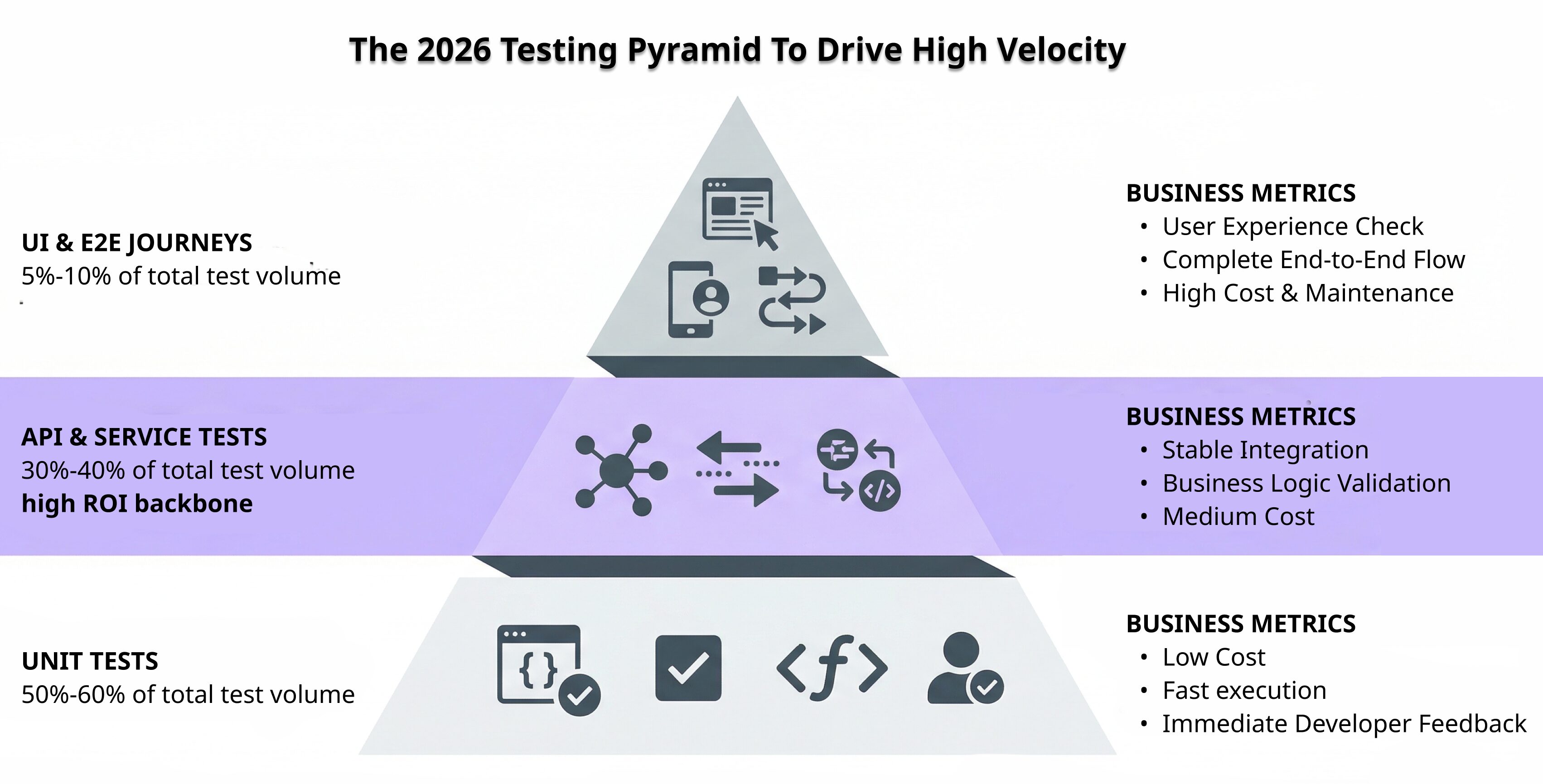
In the world of testing automation types, we use the pyramid to decide where to spend money. The idea is simple: the majority of your tests should be at the bottom (Unit and Integration), and only a few should be at the very top (UI and End-to-End).
Tests at the bottom are fast and cost pennies to run. Tests at the top (like UI) are slow, expensive, and break easily.
Imagine you are building a banking app. You should have 1,000 fast unit tests checking that the “Interest Rate” math is correct. You only need about 10 end-to-end tests that actually open a browser to simulate a user sending money. If you try to do 1,000 tests through the browser, your release will take three days instead of three minutes.
Finding a bug while a developer is still writing the code costs almost nothing. Finding that same bug after your product is live can cost 100x more in terms of emergency fixes, lost customers, and brand damage.
Think of it like building a house. It’s cheap to move a wall while it’s still just a drawing on a blueprint. It’s incredibly expensive to move that wall once the roof is on and the plumbing is finished.
So, move your test automation strategy as early into the development process as possible.
One of the biggest mistakes business owners make is thinking that once a script is written, it’s finished. In reality, every time you update your features, your tests need to be updated too.
If you don’t budget for maintenance, your tests will start giving “false failures.” Eventually, your team will stop trusting the results, and your entire investment becomes useless.
Automated tests are like a garden. If you plant the seeds (write the scripts) but never pull the weeds (maintenance), the garden will be overgrown and useless in a few months. A healthy, dedicated QA team spends about 20% of its time just keeping the “garden” clean.
A flaky test is one that fails sometimes and passes sometimes, even though nothing has changed. This is usually caused by messy test data or unstable environments.
Flakiness kills the ROI of automation testing services. You need to invest in “Infrastructure as Code” (IaC) and clean data generation so every test run happens in a perfectly clean lab environment.
Imagine testing a “Sign Up” form. If your test uses the email “test@user.com” every time, it will fail the second time because that user already exists in the database. A reliable framework creates a brand-new, unique user for every single test, so the results are always honest.
In 2026, finding a local SDET (Software Development Engineer in Test) is difficult and expensive. Many C-level leaders use QA outsourcing to bypass the hiring headache and get instant access to senior experts.
By partnering with a reputable quality assurance & testing company, you get the benefit of their existing toolstack and real-device labs without having to buy them yourself.
It’s like hiring a world-class catering company for a major event instead of trying to build your own industrial kitchen and hiring a full-time chef. You get software QA services that scale up when you have a big release and scale down when things are quiet, keeping your costs predictable.
Pros:
Cons:
Understanding what are the types of automation testing is key to digital success in 2026 and beyond. From foundational unit tests to advanced E2E, performance, and security testing, each type plays a distinct role in your product quality. Deploying these requires robust types of automated testing frameworks and the right expertise.
If your organization is struggling with slow release cycles, high bug rates, or the complexities of setting up automated workflows, we can help.
We are a premier automated testing services provider specializing in assisting digital businesses to scale with confidence. We offer comprehensive software testing services, combining advanced automation testing services — regression, performance, mobile — with strategic manual software testing when needed.
By partnering with us, you gain access to:
You can achieve predictable release cycles and superior product quality with modern automation methodologies.
Ready to transform your QA from a bottleneck into an accelerator? Learn how we can improve your development lifecycle with a wise automation strategy.
Last updated: September 9, 2026 This article compares 10 QA and software testing companies serving…
Last updated: September 9, 2026 This is a practical guide to testing mobile e-commerce apps.…
Last updated: August 31, 2026 Web applications are not generic software. They run across three…
Last updated: August 27, 2026 Most engineering teams don't have a testing problem. They have…
Last updated: August 20, 2026 Article summary: This article compares ten AI testing companies in…
Last updated: August 18, 2026 Who this article is for: SaaS teams, AI product companies,…