Most pricing guides for AI QA testing give you a number without context. The hourly rate is the least important part of the budget conversation. What actually determines the final cost is scope, team seniority, delivery model, and whether AI tooling genuinely removes enough manual effort to justify the extra layer.
This guide is built on QA Madness delivery data, real case studies from clients in supply chain, e-commerce, and healthcare, and verified benchmarks from the service pages. It also references external market sources for regional outsourcing rates, AI testing adoption, and tool-pricing models, so readers can distinguish between QA Madness delivery data and broader industry benchmarks. If you are evaluating AI-assisted QA for your product, this is the breakdown that reflects what a real engagement looks like, not a theoretical price list.
The short answer: AI-assisted QA testing typically costs $25-$85/hour in Eastern Europe and $70-$150+/hour in North America. AI tooling adds $2,000-$75,000/year on top of labor, but that is rarely the main budget driver. Scope, seniority mix, and delivery model move the number far more than the AI layer does.
What this guide covers:
AI-assisted QA testing is priced through the same labor models as standard outsourced QA, with tooling costs added on top. The labor rate depends on region and seniority; the tooling cost depends on team size and the scope of AI integration.
| Region | Standard QA Rate | Senior Automation / AI QA |
|---|---|---|
| North America | $70-$120/hr | $90-$150+/hr |
| Western Europe | $65-$120/hr | Upper range for senior AI-heavy roles |
| Eastern Europe | $30-$50/hr | $40-$65/hr |
| Latin America | $35-$60/hr | $45-$70/hr |
| Asia | $20-$40/hr | $30-$50/hr |
QA Madness operates from 3 technical offices (Cherkasy, Dnipro, and Warsaw, Poland) and prices AI-assisted QA services in the Eastern Europe range, with over 80% of engineers at Middle or Senior level. These regional ranges are aligned with external outsourcing market references. For example, Accelerance’s 2026 Global Software Development Rates and Trends Guide tracks pricing patterns across Eastern Europe, Latin America, Asia, and North America, with Central and Eastern Europe remaining significantly more cost-efficient than North American hiring for senior technical roles. ISTQB-certified specialists are available on request. The combination of senior-weighted teams and Eastern Europe pricing is what makes the model competitive for US and UK product companies.
For teams working with an external QA vendor, AI tooling costs depend entirely on how the vendor structures their delivery. Public pricing for AI and automation testing tools varies widely. TestRail’s 2026 AI testing tools comparison shows that some tools publish entry-level monthly plans, while many enterprise-grade AI testing platforms use quote-based pricing tied to seats, usage volume, parallel execution, support, and compliance requirements. Some vendors bill for tool licenses separately; others absorb them into the service fee. Sauce Labs’ 2026 AI automation testing tools comparison also shows that pricing depends heavily on usage, coverage, device access, enterprise features, and AI-powered capabilities, which is why tooling costs can vary so much between teams.
At QA Madness, AI tools are part of the delivery ecosystem. Clients are not billed separately for the tooling QA engineers use on their engagement. The cost of AI-assisted coverage is included in the service, not added as a line item on top.
If you are evaluating vendors, this is worth confirming upfront. The more relevant question is not what the tool license costs, but whether the AI layer genuinely removes enough manual effort to reduce total hours and improve output quality.
The main cost driver is still people and scope. AI changes delivery economics more than it changes the invoice total. According to QA Madness delivery data, AI-assisted testing can reduce long-term QA costs by up to 40% once the framework is stable and integrated, primarily by eliminating repetitive manual effort on regression, script maintenance, and bug reporting. This figure reflects QA Madness internal delivery benchmarks, not a universal market guarantee.
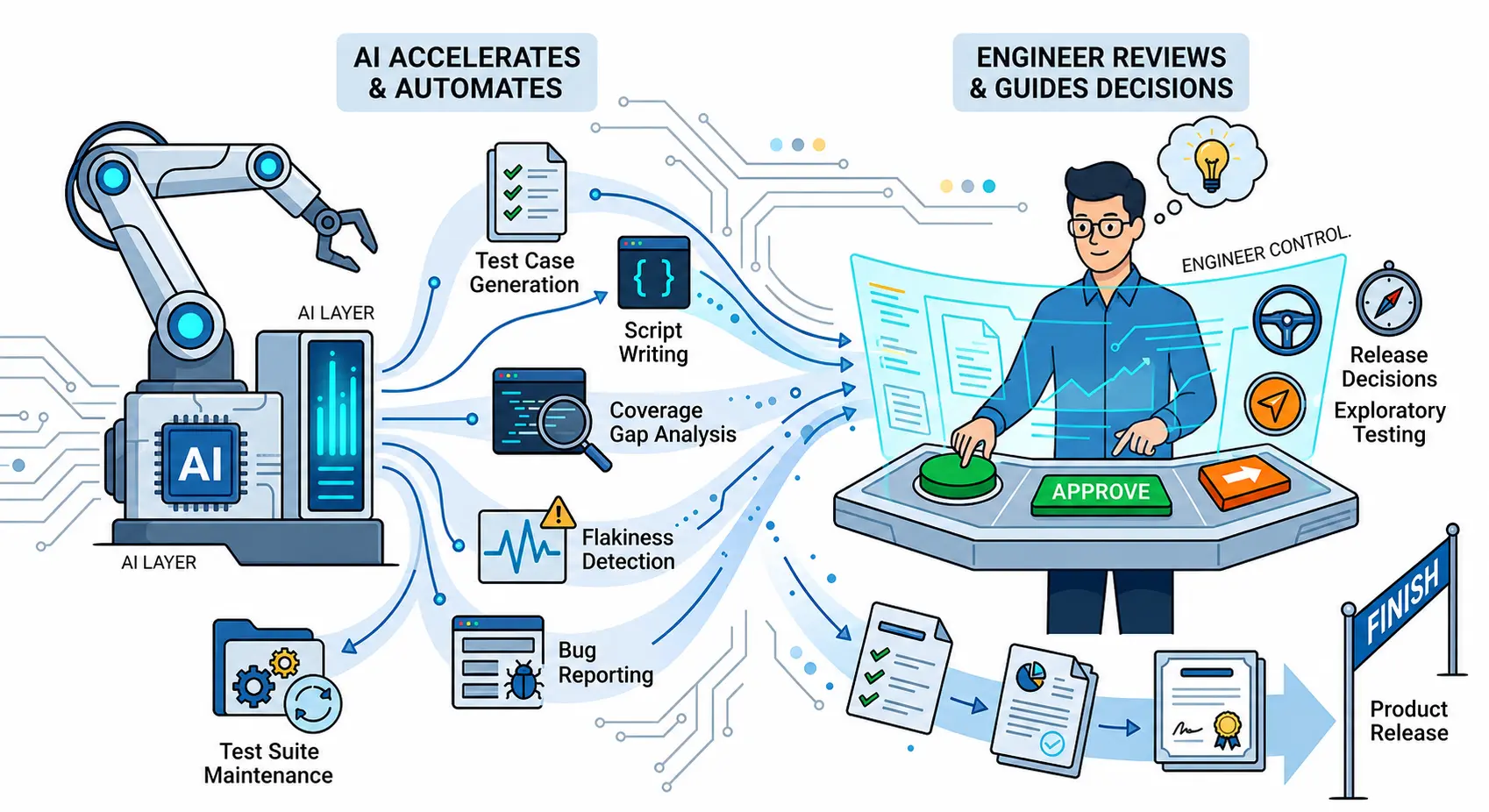
Understanding what you are paying for requires understanding how AI fits into the actual QA workflow. At QA Madness, AI-assisted testing is not a separate workflow. It is a layer that accelerates every type of testing already running on the project. Engineers stay in control: AI generates output, engineers review and approve before anything affects the product.
AI handles execution. Engineers handle judgment. Every test case, script, and bug report is reviewed and approved by a QA engineer before it affects the product. Exploratory testing, risk assessment, edge case analysis, and release decisions remain human-led.
Key implication for budgeting: The AI layer does not reduce the seniority requirement – it raises it. Validating AI-generated outputs, managing AI workflows, and catching the edge cases AI misses are senior-level tasks. This is exactly why QA Madness staffs every engagement with Middle and Senior engineers only, all working to ISTQB standards. A senior-weighted team using AI-assisted tooling covers the regression workload that previously required a larger manual team, without reducing the quality bar.
QA Madness has applied AI-assisted testing across several product types where this approach consistently delivers: a fintech investment platform, an AI-powered web and mobile app builder, and a healthtech application supporting mental health. The patterns that repeat: AI accelerates the repetitive and data-heavy parts; engineers stay in charge of the judgment calls.
The delivery model you choose affects total cost more than the hourly rate. Here is how the four main models work and when each one fits.
| Model | Best For | How Pricing Works |
|---|---|---|
| Project-Based / By Estimate | Defined scope: pre-release testing, accessibility, performance, or security testing cycles | Fixed price based on estimated workload and agreed scope |
| Hour-Based Subscription | Teams that need flexible QA support within a set monthly budget | Pre-purchased block of hours (e.g. 20 hrs/month) used within the billing period |
| Dedicated QA Team | Ongoing product development with continuous testing needs | Based on team composition, seniority mix, and scope of ongoing support |
| QA Audit | Teams that need a structured review of their QA process before committing to a longer engagement | Fixed price, structured across seven audit stages |
This model fits teams that need QA support for a defined scope: pre-release testing, a specific test type such as accessibility, performance, or security, or a time-boxed engagement before a product launch. QA Madness works with B2B software agencies and game studios that run multiple projects and need reliable QA coverage on a per-project basis. The price is based on the estimated workload and agreed scope upfront. This is handled by the QA Madness Dynamic QA team, which specializes specifically in project-based testing engagements.
For teams that need flexible QA support without committing to a full dedicated engagement, QA Madness offers hour-based subscriptions. You pre-purchase a block of hours – for example, 20 hours per month – and use them within the billing period. This works well for internal teams that need occasional QA capacity on an agreed schedule rather than full-time coverage.
The strongest fit for ongoing product development. A dedicated QA team from QA Madness integrates directly into your sprint workflow and works as a long-term extension of your engineering team. Team composition is customized based on the product’s needs: manual QA engineers, automation QA engineers, engineers who combine both, a QA Lead, and optional specialists in security or performance testing. Engagement can be structured as full-time or part-time, on an agreed schedule or a set number of hours per week. The average client retention is 4+ years.
This is the model that most often includes AI augmentation in practice, because the team has enough product context to use it well. Engineers who know the product deeply are better positioned to review AI-generated test cases and catch the ones that miss the intent.
The QA audit and consulting service is the right entry point when the team is unsure about coverage gaps, process maturity, or where to invest in QA next. It covers a comprehensive analysis across nine areas: QA process and SDLC integration, test documentation and requirements review, testing coverage, automation review and readiness, performance testing, accessibility review, team communication and workflow, and AI and workflow automation opportunities. The output is a three-part report: a detailed technical assessment with findings and recommendations, a forward-looking QA strategy, and a prioritized improvement roadmap (P0-P3). Business stakeholders also receive a concise executive summary. Fixed price, delivered in around two weeks.
Which model fits your situation:
AI is most valuable when it shortens the slowest parts of the testing workflow. The gains are real and repeatable in specific areas; in others, human judgment still leads and AI adds less value.
| Task | Without AI | With AI Assistance |
|---|---|---|
| Test cases for one feature | 3-4 hours | ~1 hour (roughly 70% faster) |
| Automating a feature’s smoke set | 1-2 days | 2-4 hours (roughly 3x faster) |
| Fixing flaky or broken tests | Manual hunt through logs and history | AI-assisted root-cause analysis |
| Failure analysis on a failed CI run | Manual triage | Faster root-cause support, quicker escalation |
| Bug report generation | Manual write-up after each failure | Full report with steps, logs, screenshots, severity |
The roughly 70% reduction in manual effort is based on QA Madness delivery data for repetitive and data-heavy QA tasks, including script generation, test updates, bug report writing, and coverage gap analysis. It should be treated as an internal delivery benchmark, not a universal industry guarantee. It applies specifically to the parts of QA that are repetitive and data-heavy: script generation, test updates, bug report writing, and coverage gap analysis.
Not every engagement benefits equally. AI pays off fastest in these situations:
It adds less value in these situations:
The honest position from QA Madness: if your product falls into the third category, the workflow runs without AI. The coverage scope, seniority mix, and delivery cadence stay the same. AI augmentation is an option, not a requirement, and the team will say so during the discovery call if it does not fit your situation.
Most pricing conversations stop at license fees and hourly rates. The real cost picture includes several items that rarely appear in a vendor’s initial quote.
Test maintenance after product changes. As a product grows, maintenance means two things: keeping existing tests working as the product evolves, and writing new tests to cover new features. AI self-healing tools reduce the first part significantly (QA Madness uses AI to auto-update selectors, flows, and assertions), but they do not eliminate either. Factor in both ongoing upkeep and new test coverage as part of the long-term cost picture.
Review time for AI-generated artifacts. AI generates test cases, scripts, and failure analysis outputs quickly. Reviewing those outputs for accuracy and relevance is still a human task. In high-velocity workflows, this review time adds up. The QA Madness model is explicit about this: every AI-generated output is reviewed and approved by a QA engineer before it affects the product.
Integration work. Connecting AI testing tools to your CI/CD pipeline, issue tracker, and reporting stack takes setup time. QA Madness integrates the first automated scripts into your CI/CD pipeline within the first weeks of engagement, not months, but that initial setup effort still appears in the scope.
Test documentation and coverage structure as a one-time investment. If no test documentation exists yet, building it from scratch is a front-loaded effort that pays off over subsequent releases. The Calcurates case illustrates this: the checklist and coverage structure built during the first engagement was still being used in subsequent testing rounds, compounding its value over time.
Data governance and security controls. Some AI tools process application data, test inputs, or log outputs. If your product handles sensitive data, QA Madness follows a defined AI Policy with clear rules based on the client’s security protocols and AI usage requirements. This is handled at the engagement level, not as an add-on, and applies across all industries including healthcare and fintech.
The World Quality Report 2025 makes the same point at market level: while most organizations are piloting or deploying GenAI-augmented quality engineering workflows, enterprise-scale adoption remains limited. The report highlights integration complexity, data privacy risks, and hallucination or reliability concerns as major barriers, which is why governance and human review remain part of the real cost picture.
The right question is not “What does the AI tool cost?” It is “How much manual effort does it remove without creating noise?” AI can lower effort in one part of the workflow while increasing review load in another. A credible vendor will be honest about both sides of that equation during the discovery call.
Two teams can receive very different quotes for “AI QA testing services” because the scope variables are wide. These are the factors that move the number most.
Testing scope. Web testing, mobile testing, performance, security, or accessibility – each adds to the scope. A broader testing mix catches a different class of defects: functional bugs, integration issues, and performance bottlenecks require different coverage than UI testing alone.
Coverage depth. A smoke test suite is not the same as comprehensive regression, performance, and security coverage. AI reduces the per-test cost of reaching high coverage, but the scope decision still drives the budget. The QA Madness QA audit service is often the right first step when coverage depth is unclear. It produces a three-part output: a technical assessment, a forward-looking QA strategy, and a prioritized improvement roadmap – before any testing work begins.
Engagement duration. Part-time or project-based engagements may carry a higher hourly rate than a full-time dedicated model. In both cases, the deliverable and expected outcome are clearly defined upfront. The longer the engagement, the more the setup investment compounds – which is reflected in the QA Madness average client retention of 4+ years
Seniority mix. All QA Madness engineers are Middle or Senior level. A senior-weighted team costs more per hour but produces fewer defect escapes, faster ramp-up, and better test architecture. The per-hour rate is not the right unit for measuring value.
AI tooling already in place. If the vendor brings their own AI testing infrastructure, you benefit from their investment without paying for it separately. Custom framework builds appear as setup cost in the initial scope.
The last question matters more than it appears. A vendor that can only deliver with AI tooling has a different risk profile than one that uses AI as an accelerant on top of a proven manual and automated QA foundation.
Pricing benchmarks are useful context. Real project data is more instructive. These two cases are from the QA Madness case study library and illustrate how scope decisions and AI product complexity shape the cost structure.
Apollo.ai is an intelligent board and decision cloud that integrates AI directly into online meeting workflows to automate decision tracking and surface actionable insights for leadership teams. QA Madness was brought in to build the testing process from scratch.
The scope challenge: Testing an AI-powered SaaS platform presents distinct challenges: AI-generated outputs are non-deterministic, user roles and access levels create complex permission matrices, and real-time collaboration features must hold up across devices, browsers, and concurrent sessions. The team had no QA engineer in place and the project manager was handling testing.
What the team did:
The cost implication: The engagement runs part-time, with the QA engineer joining Apollo.ai’s team for one week per sprint. This is the economics of the part-time model: defined scope, predictable cost per sprint, and no full-time overhead. The checklist and coverage structure built in the early sprints continues to serve as the foundation for every subsequent release cycle.
This project involved building and testing an AI-powered assistant that guides users through the Canadian immigration program application process. Powered by NLP and machine learning, the tool delivers personalized eligibility assessments and instant conversational responses. QA Madness contributed manual QA as part of a full delivery team.
The scope challenge: The product combined AI eligibility logic, a conversational AI component, Calendly integration, and a custom GPT for the GPT store. Testing covered both standard functional and UI scenarios and AI-specific validation: NLP edge cases, response consistency, and regression testing after each model update.
What the team did:
The cost implication: The engagement was structured by estimate, with a defined scope and fixed price agreed upfront. This is the right model when the deliverable is clear but the product is technically complex. AI-specific testing adds scope compared to standard functional testing, because validating non-deterministic outputs requires additional test design and review effort that does not exist in conventional QA.
It depends on region, scope, and team structure. For a dedicated outsourced QA team with AI-assisted delivery, the cost is driven by the number of engineers and their seniority, not by the AI tooling itself. AI tooling adds $2,000-$15,000 per year for small teams, on top of labor. The tooling is a secondary cost, not the primary one.
Usually not. For most teams, AI tooling is a modest addition compared with labor. The more relevant question is whether it removes enough manual effort to reduce total hours and improve output quality. QA Madness data shows a reduction in long-term QA costs of up to 40% once the AI-assisted framework is stable and integrated.
Use time and materials or fixed-price for one-off projects, audits, or pilots with defined scope. Use a dedicated QA team if you have ongoing product development and want testing integrated into your CI/CD pipeline long-term. A QA audit is often the right first step if you are unsure about scope: it produces a prioritized roadmap before any testing work begins.
It depends on what is in scope. AI-augmented testing can cover UI, visual regression, accessibility, and end-to-end flows on the frontend, and API, integration, performance, and security on the backend. Always confirm whether backend coverage is included in a quote. Many vendors default to UI-only automated testing.
Yes. If a client does not want AI used in the delivery process for any reason, including compliance requirements, data privacy policies, or internal standards, QA Madness delivers a fully human-led engagement. The scope, seniority mix, and coverage depth stay the same.
Sometimes. AI pays off fastest when release frequency is high, regression volume is growing, and test maintenance already consumes too much team time. For small, stable products with low change velocity, the benefit may be limited. The QA Madness discovery process includes an honest assessment of where AI tooling will actually help and where it will not.
QA Madness can onboard a dedicated QA team within 1-3 days. For AI-assisted delivery, the first automated scripts are integrated into your CI/CD pipeline within the first weeks of engagement, not the first quarter.
Confirm which platforms are in scope – web, mobile, desktop, or a combination – which test types are required, what integrations are needed, whether team management is included, and whether the vendor can deliver without AI if required.
AI QA pricing in 2026 is not one number. It is a combination of coverage scope, team seniority, delivery model, and regional rates – with a clear roadmap and defined deliverables tied to each engagement. The right vendor should be able to tell you what outcomes to expect and in what timeframe, not just quote an hourly rate.
The right question is not “How do I minimize the QA budget?” It is “Which engagement model and coverage scope will give me predictable costs and release confidence?” Those are different questions, and the answer to the second one is what separates teams that ship with confidence from teams that find critical bugs in production.
Last updated: 9 October 2026 This guide explains how to measure and reduce test automation…
Last updated: 8 October 2026 This guide compares 10 companies that build and run automated…
Last updated: 2 October 2026 This guide compares 10 companies that sell manual software testing,…
Last updated: 2 October 2026 This guide explains how to build a performance testing programme…
Last updated: 29 September 2026 This guide compares ten QA companies that test gaming apps,…
Last updated: September 23, 2026 This guide explains API contract testing for microservices: what it…