QA MadnessBlog QA Automation Services: What You Get and How to Evaluate Providers
QA Automation Services: What You Get and How to Evaluate Providers
Reading Time: 11minutes
Last updated: August 6, 2026
Most teams that struggle with QA automation do not have a tooling problem. They have a vendor problem. They hired a provider that can produce test scripts, but cannot explain what those tests protect, cannot connect coverage to business risk, and cannot keep the system maintainable as the product evolves.
The market has moved. According to the 2025-2026 State of Testing report by PractiTest, AI adoption is now common in QA workflows. That raises the baseline. If a provider still treats automation as a collection of scripts instead of an engineering system, they are behind the market.
This article focuses specifically on web automation for teams building automation from scratch or near-scratch. Mobile automation is a related track but requires a separate tooling discussion. And if your project already has an existing automation suite you want to hand off to an outsourced team, that scenario deserves its own evaluation framework, since the priorities shift toward supporting and stabilizing the current stack rather than designing from zero.
For modern web automation, the stronger default for new initiatives is now Playwright. It is better aligned with current web applications, CI/CD workflows, and the reliability standards teams expect from automated testing in 2026.
Key Takeaways
➛ A good QA automation provider delivers a maintainable test system, not just scripts.
➛ This article is about web automation for projects where automation is only now being introduced.
➛ For new web automation initiatives, Playwright is now the more modern default for most teams in 2026.
➛ Cypress, Selenium, and WebdriverIO still hold a significant share of real-world projects and remain valid choices, especially when extending or supporting an existing stack.
➛ CI/CD integration, maintenance discipline, visible reporting, and clear ownership matter more than tool name-dropping.
➛ AI can accelerate requirements analysis, test creation, maintenance, and result analysis, but QA engineers remain accountable for all output.
➛ A POC project is still the best way to reduce vendor risk before signing a long-term contract.
What Should QA Automation Services Actually Include?
A QA automation service should deliver a working, maintainable quality system integrated into your release process. If a vendor cannot define the deliverables clearly, the engagement will likely drift.
A well-scoped engagement usually includes:
➛ an automation readiness assessment
➛ framework design and architecture
➛ test implementation for agreed coverage
➛ CI/CD integration
➛ reporting and failure diagnostics
➛ ongoing maintenance and optimization
This article is focused on web automation. The main tools in this space are Playwright, Cypress, Selenium, and WebdriverIO. Mobile automation is a different track: it typically relies on Appium, usually paired with WebdriverIO or Selenium-based infrastructure. Mixing these two tracks in one undifferentiated conversation creates confusion, so it is worth being explicit about which one you are evaluating for.
It is also worth drawing a line between two distinct scenarios:
Scenario
What the provider should optimize for
New automation initiative
Choosing the right stack, building the framework, setting coverage priorities
Existing automation being outsourced
Supporting the current stack, stabilizing it, and potentially modernizing it over time
This piece focuses on the first case: projects where automation is only now being introduced or formalized. The second scenario often deserves a separate evaluation because inherited Selenium or Cypress suites create a different delivery model.
A serious provider starts with assessment, not a tool pitch. The first step should be understanding your release cadence, existing QA process, highest-risk user flows, and where defects escape today.
A useful assessment phase should produce:
➛ a prioritized list of what to automate first
➛ clear ROI logic for each coverage area
➛ recommendations tied to your stack and workflow
➛ a view of what should remain manual
That matters because not everything should be automated. Teams get the highest return by automating stable, repeatable, high-impact scenarios first, then expanding coverage over time.
For new web automation initiatives, this is also the stage where a strong provider explains why Playwright may be the default recommendation while still acknowledging that Selenium, Cypress, and WebdriverIO remain valid in specific contexts. These tools still account for a significant share of real-world automation environments. A vendor that treats them as automatic red flags is oversimplifying the market.
2. Framework Design and Test Architecture
This is where good and bad vendors separate quickly. Framework design determines whether your test suite becomes a long-term asset or a maintenance burden.
For modern web products starting automation in 2026, Playwright is often the right default for the UI layer. It supports auto-waiting, resilient locators, parallel execution, tracing, and cross-browser testing across Chromium, Firefox, and WebKit from a single framework. That said, a capable provider should also be ready to work with Cypress, Selenium, or WebdriverIO when the product context or existing ecosystem calls for it.
A healthy automation architecture for web projects usually looks like this:
Test layer
Typical share of effort
Why it matters
API and integration tests
~60-70%
Fast, stable, catches business logic issues early
Critical UI flows
~20-30%
Protects revenue-critical and user-critical journeys
Edge cases and selective experiments
~10%
Covers high-risk scenarios without bloating maintenance
That distribution matters because UI automation is the most expensive layer to maintain. A vendor that leads with UI-heavy coverage by default is often optimizing for demos, not for long-term efficiency.
For a practical example of how QA Madness approaches modern web automation, see our Web Application Testing service overview.
3. Test Development and CI/CD Integration
A real automation engagement ends with tests running inside your delivery workflow, not sitting unused in a repository.
Minimum deliverables should include:
➛ an automated regression suite for the agreed scope
➛ integration with GitHub Actions, GitLab CI, Jenkins, or Azure DevOps
➛ reporting on pass rates, failures, and trends that all relevant stakeholders can review
➛ documentation for maintenance and ownership
Why this matters is simple. If developers learn about regressions hours or days after the fact, the feedback loop is too slow to be useful.
Good reporting is not just about generating logs. It is about making the state of the automation suite visible to everyone who needs to act on it: QA leads, developers, product managers, and other stakeholders. That usually means dashboards, failure summaries, historical trends, and clear ownership of what happens next. When the right people can see what is passing and what is failing in real time, decisions happen faster.
Industry reporting has consistently pointed in the same direction: teams that integrate automated checks into CI/CD move faster and catch defects earlier. Playwright also supports parallel test execution well, which makes it a strong fit for fast feedback in modern web pipelines.
4. Ongoing Maintenance and Optimization
Automation is not a one-time build. It is an ongoing system that needs upkeep as the product changes.
A provider should be responsible for:
➛ fixing broken tests after product changes
➛ reducing flaky behavior
➛ expanding coverage as features ship
➛ refactoring unstable suites
➛ keeping the framework current
This is one of the best filters during vendor evaluation. Ask what percentage of time their teams spend maintaining existing tests versus building new coverage. If they cannot answer, that is a warning sign.
A practical benchmark for suite health is overall pass rate. Mature automation programs typically aim to keep pass rates at 95-97% for stable runs, with failures signaling real product issues rather than noise from flaky tests. Once teams stop trusting test results, the suite loses most of its value.
5. How AI Fits Into Modern QA Automation
AI is now part of the evaluation. Not because it should replace QA engineers, but because providers should know where it creates real leverage and where it still needs human control.
In practical terms, AI can help at several stages of the automation process:
➛ Requirements analysis – identifying test scenarios and edge cases from specs or user stories faster than manual review
➛ Test creation – drafting automated test cases that engineers then review and refine
➛ Test maintenance – detecting and fixing broken tests after product changes, reducing the manual effort of keeping suites current
➛ Result analysis – identifying patterns in failures, separating flaky behavior from real regressions
This is one reason Playwright is increasingly attractive for new web automation initiatives. Its structure and tooling integrate well with AI-assisted workflows, making it easier to generate, review, and maintain tests at scale.
But this needs guardrails. AI should only be introduced when the client is comfortable with it. And regardless of how much AI is involved in the process, the responsibility for final quality decisions stays with the QA team. A serious provider should be able to explain exactly where AI is used, where it is not, and how human review remains part of every step.
AI can accelerate parts of the automation process, but QA engineers must remain accountable for validation, review, and final release confidence.
If a provider talks about AI only in abstract terms without describing concrete use cases, review steps, or quality controls, that is not maturity. That is marketing.
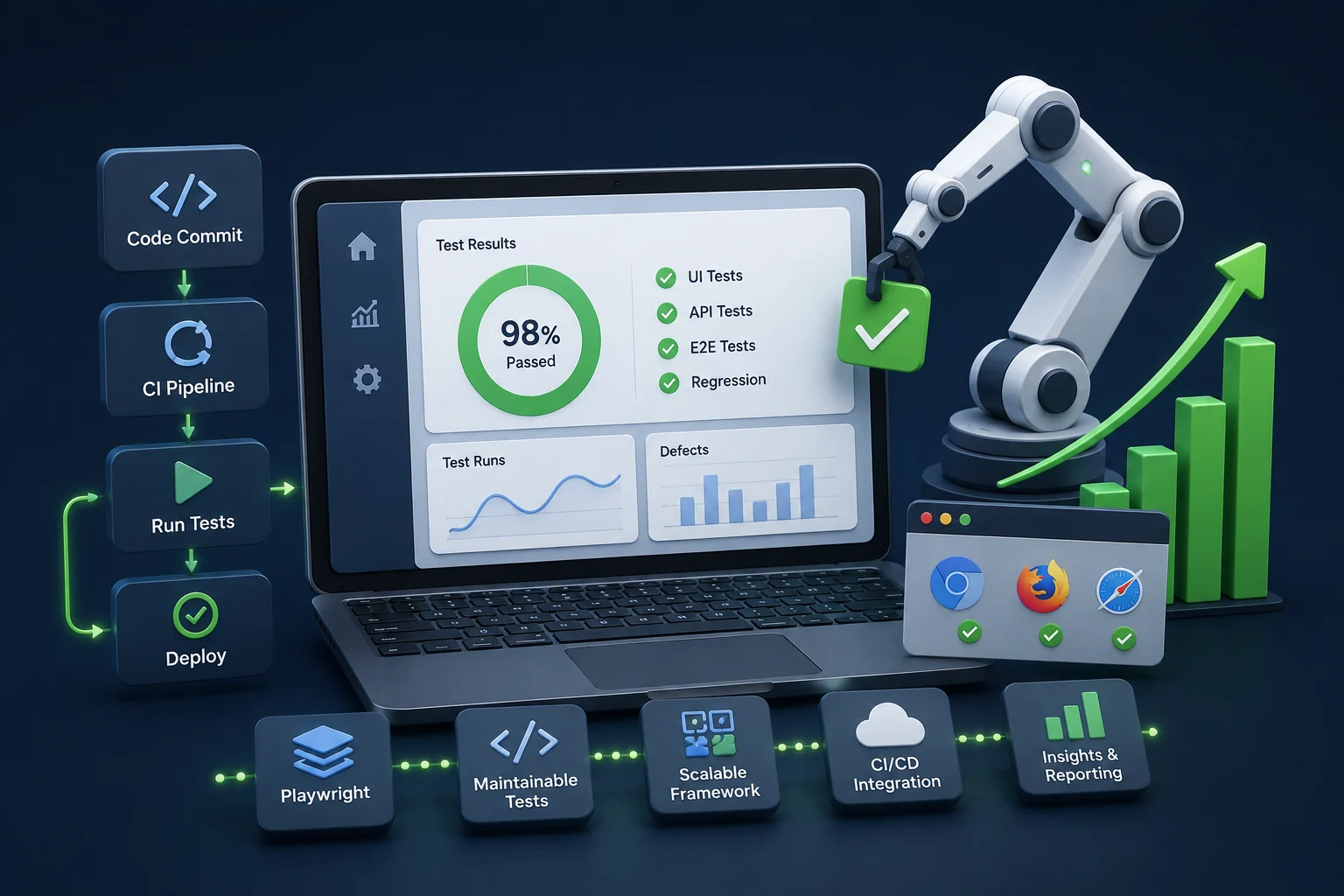
Modern QA automation is more than test scripts. A mature automation system combines framework design, CI/CD integration, reporting, maintainability, and continuous optimization.
How to Evaluate QA Automation Providers
Price and tool familiarity are weak evaluation criteria. The better signals are technical maturity, process discipline, communication, and security posture.
1. Technical Maturity
Any vendor can list Playwright, Cypress, Selenium, and Appium on a services page. That does not prove they can design a reliable system.
Ask for:
➛ their recommended automation architecture for your specific product and pipeline
➛ how they would approach CI/CD integration for your delivery model, and what they would recommend given your setup
➛ regression cycle reduction metrics
➛ pass rate or flakiness benchmarks from active engagements
➛ how they handle test maintenance after major product changes
The strongest providers can explain not just what they automate, but why. And for new web projects, recommending Playwright as the default is reasonable. For existing outsourced automation, the stronger answer is: we can support your current Selenium, Cypress, or WebdriverIO stack, stabilize it, and then recommend whether modernization makes sense.
2. Domain Fit
A vendor should adapt the automation strategy to your product type. Fintech, healthcare, ecommerce, SaaS, and internal enterprise systems all create different testing risks.
You want a provider that can explain:
➛ what gets automated first in your domain
➛ what remains manual
➛ what compliance or data-handling constraints matter
➛ which user journeys create the highest business risk
Broad testing experience improves prioritization, not just execution.
3. Security and Access Controls
An external QA team may gain access to source code, staging environments, test data, and deployment workflows. Security cannot be treated as secondary.
Requirement
Why it matters
SOC 2 or ISO 27001
Shows formal security controls exist
NDA before technical discovery
Protects product and IP details
Data-handling policy
Defines how test data is managed
Access control process
Limits exposure to what the team actually needs
Exit and data-retention terms
Reduces post-engagement risk
Knowledge transfer plan
Ensures the test suite and its documentation remain usable if the engagement ends
The knowledge transfer point is worth calling out directly. A common client question is: what happens to everything you built if we stop working together? A reliable provider should have a clear answer: structured handover of documentation, framework knowledge, and maintenance context so the test assets stay usable after the engagement.
If a provider cannot show this clearly, that is not a paperwork issue. It is a risk issue.
4. Communication and Process
The way a vendor communicates during evaluation is often the best predictor of how they will behave during delivery.
Look for:
➛ a named point of contact
➛ a clear escalation path
➛ reporting cadence
➛ sprint alignment
➛ documented handling of timezone overlap if relevant
Vague answers during sales usually become vague accountability later.
Red Flags That Should End the Conversation
Some warning signs are not subtle. They should disqualify the provider.
Technical red flags
➛ They lead with a tool list, not a strategy.
➛ They cannot explain coverage priorities.
➛ They cannot show metrics from past engagements.
➛ They push UI automation as the main layer by default.
➛ They treat Cypress, Selenium, or WebdriverIO as automatic red flags rather than explaining when and why each tool fits.
➛ They talk about AI in abstract terms but cannot describe any concrete use cases, review process, or quality controls.
Operational red flags
➛ High team turnover
➛ Refusal to run a POC
➛ Unclear ownership of deliverables
➛ Pricing far below market without a clear reason
Contract red flags
➛ no exit clause
➛ no knowledge transfer requirement
➛ vague scope
➛ no SLA for maintenance or support
➛ unclear IP ownership of test assets
Questions to Ask Before You Sign
These questions usually expose whether a vendor actually knows what they are doing.
On technical capability
1. What would your recommended automation architecture look like for our stack?
2. What percentage of your active projects run tests in CI/CD on every pull request or commit?
3. What pass rate do you consider healthy, and how do you improve it when it drops?
4. How do you handle test maintenance after major UI changes?
On tooling
1. Why do you recommend Playwright or another tool for our UI layer specifically?
2. If we already use Selenium, Cypress, or WebdriverIO, how would you approach supporting or modernizing that stack?
3. How do you keep browser tests fast, stable, and reviewable in CI?
On AI usage
1. Where do you use AI in the automation process today?
2. What review steps do your QA engineers apply to AI-generated artifacts?
3. What changes if we prefer not to use AI in the engagement?
On process
1. Who owns communication and escalation?
2. How do you handle a critical defect found right before release?
3. Can you describe a project that went off track and how you recovered it?
On contract and exit
1. If we bring automation in-house in 12 months, what exactly gets handed over?
2. What does your knowledge transfer process look like at the end of an engagement?
Why a POC Project Still Matters
A POC is still the cleanest way to reduce vendor risk. It replaces sales claims with observable delivery.
A good POC should include:
POC element
What to require
Scope
One critical workflow or regression-heavy module
Integration
Tests run in your actual CI/CD pipeline
Deliverables
Test cases, coverage summary, pipeline setup, maintenance notes
Measurement
Time spent, tests delivered, integration success, stability
The goal is not to judge presentation quality. The goal is to see how the team works with your product under real conditions.
After the POC, evaluate three things:
➛ Technical quality – are the tests maintainable, documented, and stable?
➛ Process quality – did they communicate clearly and meet commitments?
➛ Cultural fit – do they understand the product well enough to challenge assumptions?
That third point gets overlooked. The best QA partners do not just execute tickets. They ask sharper questions, challenge weak assumptions, and improve coverage decisions.
Choosing the Right QA Automation Partner
The difference between a useful automation engagement and an expensive one is rarely the logo on the framework. It is whether the provider treats automation as a strategic engineering capability.
The best partners do a few things consistently:
➛ prioritize coverage by business risk
➛ build around maintainability
➛ integrate directly into CI/CD
➛ report clearly to all relevant stakeholders
➛ make handover possible if the relationship ends
If you are evaluating vendors, the practical rule is simple: demand specifics. Specific architecture decisions. Specific maintenance expectations. Specific metrics. Specific exit terms. Vague answers now usually mean vague accountability later.
Ready to assess what a structured automation engagement could look like for your product? Talk to the QA Madness team. With 10+ years of experience across web, mobile, and API testing and a 4.9 rating on G2, the conversation starts with your stack and your goals.
Frequently Asked Questions
What does a QA automation service actually deliver?
A QA automation service should deliver a maintainable test system integrated into your CI/CD workflow, not just scripts. That usually includes assessment, framework design, implementation, reporting, pipeline integration, and ongoing maintenance.
Why is Playwright a stronger choice for browser automation in 2026?
For many new web automation initiatives, Playwright is a stronger default because it supports modern browser automation with built-in auto-waiting, resilient locators, tracing, parallel execution, and cross-browser coverage from one framework. It is not the only valid tool, but it is often the most practical starting point for new browser-based automation in 2026.
Does this article apply to mobile automation too?
Not directly. This article is focused on web automation. Mobile automation usually requires a separate tooling discussion centered on Appium, typically combined with WebdriverIO or Selenium-based infrastructure.
What if we already have Selenium, Cypress, or WebdriverIO tests?
That is a different but common scenario. A strong provider should be able to support the existing stack, improve stability, and recommend whether a gradual migration to a newer approach makes sense. That scenario typically deserves a separate evaluation from building automation from scratch.
How long does it take to set up QA automation from scratch?
Most teams can reach an initial working suite in four to eight weeks, depending on the application, scope, and CI/CD maturity. Critical-path coverage usually comes first, with broader regression coverage expanding after that.
What should stay manual instead of automated?
Exploratory testing, visual judgment, fast-changing features, and ambiguous workflows often stay manual. Automation works best for stable, repeatable, high-value scenarios.
What happens to the test suite if we change vendors?
A good provider will define IP ownership, documentation requirements, and a knowledge transfer process in writing before the engagement starts. That means structured handover of the framework, test documentation, and maintenance context so the suite stays usable after the relationship ends. If those terms are vague, switching will be harder and more expensive than it should be.
What is the best way to evaluate a QA automation provider before signing long term?
Run a scoped POC. It is the fastest way to verify technical quality, process discipline, and communication style using your real product and release workflow.
Our blog posts are available in audio! Listen on the go and when you want to learn something new but don’t feel like reading. Your browser does not support the audio tag. Updated: 5 Jun 2026 Software test automation services are an essential part of the quality control process. Unlike manual testing, it uses special software for the implementation of test processes and assisting in test management, design, execution, etc. To run automated tests, QA engineers apply a ready-to-use tool or solutions that require writing additional code. We’ve already told about the ultimate goal and key objectives of software testing in one of our previous blog posts. But what about automation? Are there any specific automation testing goals and objectives? Let’s figure it out. What Are the Goals of Automated Testing? A fast-paced software development environment requires dynamic testing solutions. Automation helps to speed up the process, covering more test areas in less time. As a result, QA...
The best software testing tools in 2026 span five categories: performance testing (Apache JMeter, k6), test automation (Playwright, Selenium, Cypress), unit testing (Vitest, Jest), test management (TestRail, Qase), and bug tracking (Jira, Linear). This guide covers 12 essential tools QA teams rely on daily – updated to reflect the shift toward AI-assisted testing and modern JavaScript-first frameworks that have replaced many legacy tools from previous years. Originally published: February 11, 2016 | Updated: June 5, 2026 What Are the Best QA Testing Tools in 2026? Modern QA teams need tools that integrate tightly with CI/CD pipelines, support AI-assisted testing, and work natively with JavaScript-first stacks. Below are 12 tools that cover the five core categories every QA organization needs. Performance Testing Tools Here are the most important tools to test the performance, load, and stress of your website or application. Apache JMeter is a 100% pure Java desktop application d...
Most engineering leaders don't outsource QA because they planned to. They outsource because a release slipped, the hiring pipeline stalled, or the team simply doesn't have QA coverage at all. By that point, the decision is reactive rather than strategic - and reactive decisions cost more. But there are equally valid reasons to outsource from the start: you need a team that already has QA processes in place, you want to scale testing capacity quickly without building a department, you're looking for access to diverse devices and platforms your in-house team doesn't have, or you need short-term coverage without a long-term headcount commitment. Sometimes it's simpler than that - you don't have a recruitment team, and hiring QA engineers takes months you don't have. This guide is built for CTOs, Heads of Engineering, and Product leaders who want to make this decision strategically, not under pressure. It covers the four decisions that actually matter: whether to outsource at all, wh...
Last Updated: June 2026 A dedicated QA team is a team of quality assurance specialists who work exclusively on a single product or project. Unlike developers who split their focus between coding and testing, dedicated QA professionals concentrate entirely on identifying defects, improving software quality, and ensuring a reliable user experience through functional, regression, performance, and compatibility testing. Testing is irreplaceable. And the way you approach it is everything. From the Therac-25 disaster to Boeing 737 Max crashes – you know that quality assurance can make or break your business. Hence, for your product to be superior, you need a QA team that can support your vision. What kind of a team it should be? Let’s find out. Dedicated QA Team vs Dedicated Testing Team: What's the Difference? The terms "dedicated QA team" and "dedicated testing team" are often used interchangeably - but they don't mean exactly the same thing. A dedicated testing team...
Last updated: July 28, 2026 Poor software quality is expensive. CISQ estimates that poor software quality cost the U.S. economy $2.41 trillion in 2022, with $1.52 trillion tied to operational failures and technical debt. At the team level, hidden quality costs can reach $55,000 to $78,000 per developer per year. But not every quality-related engagement should start with the same framing. When companies look for QA consulting, they are not always trying to investigate what is broken. Often, they already know what they want to do. They want to build a QA function from scratch. Replace fragmented testing practices with a unified process. Introduce automation into a manual-heavy workflow. Expand quality operations to support faster releases, a larger product, or a more complex engineering team. That is where QA consulting should be positioned clearly. A QA audit is primarily about diagnosing quality gaps, delivery risks, and their root causes. QA consulting goes further. It ...