Last updated: June 2026
A poorly configured load test doesn’t just miss bugs – it gives you false confidence before peak traffic hits. The difference between a vendor that runs JMeter scripts and one that actually engineers a performance testing program is the difference between catching a bottleneck in staging and explaining an outage to your CTO.
Performance testing is a distinct discipline. It requires engineers who understand infrastructure behavior under load, not just testers who know how to record HTTP traffic. The market is full of QA generalists who list “load testing” as a service. Finding a vendor with genuine depth in scenario design, stateful test scripting, and bottleneck analysis is harder than it looks.
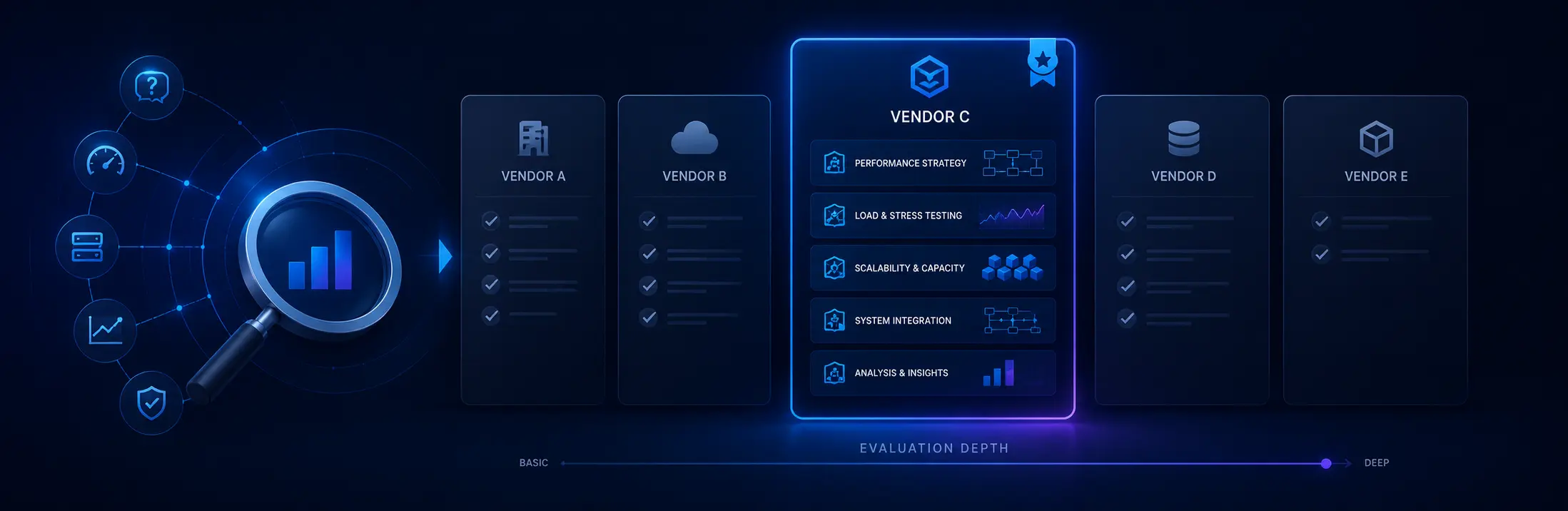
This ranking evaluates the ten best performance testing companies in 2026 across five criteria:
Any vendor that couldn’t demonstrate CI/CD integration with documented outcomes was excluded from consideration. If you’re evaluating performance testing partners for 2026 – or trying to understand what separates a real performance engineering practice from a checkbox service – this is where to start.
For a broader look at QA vendors across all testing disciplines, see our full ranking of top QA testing companies in 2026.
Every vendor on this list was evaluated against the same six-criteria framework. The goal was to distinguish genuine performance engineering capability from “we also do load testing” positioning.
| Criteria | What We Measured |
|---|---|
| Criteria | What We Measured |
| Testing types covered | Load, stress, spike, soak, scalability, volume |
| Tool stack | JMeter, k6, Gatling, Locust, BlazeMeter, LoadRunner |
| CI/CD integration | Native pipeline integration, not just manual runs |
| Reporting quality | Real-time dashboards, bottleneck identification, actionable insights |
| Industry experience | Regulated industries: fintech, healthcare, e-commerce |
| Client ratings | Clutch, G2, GoodFirms – minimum 4.5 across two platforms |
The key filter: vendors that couldn’t show evidence of CI/CD-integrated performance testing with documented outcomes – not just a services page claiming the capability – were excluded. Ratings are sourced from Clutch, G2, and GoodFirms as of June 2026.
Before engaging with any vendor on this list, confirm these five things:
QA Madness has been doing performance testing since 2013, and the way they work hasn’t changed much since then: senior engineers stay on the project from start to finish. That sounds like table stakes, but it’s rarer than it should be. Most vendors at this scale rotate junior resources across accounts once the contract is signed. Here, the people who design the test scenarios are the same people investigating bottlenecks and writing the remediation recommendations.
Their performance testing practice covers everything from baseline load profiling and spike testing to long-running endurance tests for memory leak detection and scalability assessments that catch infrastructure limits before they turn into production incidents.
The results clients report tend to be concrete. In one mobile gaming project covering functional, compatibility, and performance testing across iOS and Android:
“QA Madness has completed the tests successfully and identified existing issues, helping the client improve the game’s stability and reduce crash rates. The team provides timely, reliable support and proactively communicates and resolves issues.” (Clutch, verified review)
That kind of outcome matters because load metrics alone don’t tell the whole story. What engineering teams actually need is someone who can trace a performance issue back to its root cause and tell them what to fix.
Reporting is one of the areas clients bring up most often. The feedback isn’t just “good reports” but specifically that the analysis goes deeper than dashboards, identifies what actually caused the issue, and gives engineering teams something actionable to work with:
“They’re unique in their detailed reporting and their ability to find bugs in places that weren’t thought of.” (Clutch, verified review summary)
On the tooling side, QA Madness picks tools based on what fits the project rather than defaulting to one stack. k6 is the go-to for modern DevOps environments because tests are written as code, live in version control, and plug directly into CI/CD pipelines. JMeter comes in when the protocol complexity or scenario customization requirements call for it. It’s a small distinction that signals a lot about how they think about the work.
Engagements can start small. A focused pre-launch performance audit or traffic-readiness assessment is a common entry point. From there, teams often move into longer-term programs embedded in their development pipelines. For anyone looking for a broader starting point, their QA audit and consulting service is structured to produce decisions, not just documentation.
What sets them apart: Senior engineers on every engagement, reporting that goes beyond metrics to root-cause analysis, and a consistent track record of improving application stability in production-critical environments.
Ideal for: Mid-to-large SaaS, fintech, healthcare, and e-commerce teams that need real performance engineering expertise without building an in-house team from scratch.
Tricentis is one of the few performance testing vendors with native SAP performance testing capability – a rare and genuinely valuable differentiator for enterprises running SAP landscapes. Their Flood platform handles cloud-based load generation at scale, with geographic distribution across AWS, Azure, and GCP regions.
The enterprise positioning is real: Tricentis appears consistently in Gartner research, and their customer base skews toward large organizations with complex, multi-system environments where performance testing requires coordination across application, infrastructure, and database layers simultaneously.
What sets them apart: Native SAP and Salesforce performance testing – a capability most independent QA vendors cannot replicate.
Ideal for: Enterprise IT teams running SAP or Salesforce at scale who need a vendor that understands platform-specific performance constraints.
Abstracta’s performance testing practice is built on genuine open-source depth. The team includes contributors to JMeter and Taurus, which translates into a level of tool mastery that distinguishes them from vendors who simply use these tools. For organizations with complex, custom performance testing requirements, that engineering depth matters in ways that become visible quickly: script maintainability, edge case coverage, and the ability to model unusual load patterns.
Their case studies include named enterprise clients with documented outcomes rather than marketing summaries. That transparency is unusual in the QA market and signals confidence in results that generalist vendors rarely demonstrate.
What sets them apart: Open-source tool contribution depth – engineers who built parts of the tools they use, not just certified users.
Ideal for: Tech-forward organizations with complex performance testing requirements that need custom scripting and engineering-level expertise.
DeviQA is a global QA company with 250+ engineers and a performance testing toolkit that covers the full range of load scenarios – from baseline load and stress testing through spike, endurance, and scalability. Their multi-vertical experience across fintech, healthcare, retail, and e-commerce means the team is familiar with the performance demands of different system types, not just generic load generation.
The multi-geography delivery model keeps pricing competitive without sacrificing technical depth – a practical option for organizations that need real performance testing capacity without the overhead of a large enterprise vendor.
What sets them apart: Broad vertical coverage combined with a flexible engagement model that scales from on-demand engineers to fully managed QA programs.
Ideal for: Organizations that need performance testing across multiple product types or verticals and want a mid-size vendor with enough depth to handle complex scenarios.
Cigniti holds CMMI Level 5 certification – the highest process maturity designation available – and appears consistently in Gartner, Forrester, and Everest Group research on application testing services. For regulated industries where performance testing must produce compliance-grade documentation alongside technical results, that combination is difficult to match.
Their performance testing practice is particularly strong in BFSI and healthcare, where transaction throughput, regulatory SLA compliance, and audit trail requirements add complexity that generalist vendors struggle with.
What sets them apart: CMMI Level 5 plus analyst recognition trifecta (Gartner, Forrester, Everest) – the strongest independent credentialing available in the QA market.
Ideal for: Enterprise procurement teams in healthcare, financial services, or defense that need a vendor with formal analyst validation and compliance-grade process documentation.
Qualitest operates at a scale that few independent QA vendors can match. With 1,500+ engineers across global delivery centers, their performance testing practice covers everything from API-level throughput testing to full-system load simulations for enterprise platforms. The Gartner Peer Insights rating of 4.7 reflects consistent delivery at enterprise scale.
The firm’s telecom and BFSI experience is particularly deep, with documented capability in high-transaction-volume environments where performance testing requires coordination across distributed infrastructure.
What sets them apart: 1,500+ engineer scale with genuine enterprise delivery capability – relevant for organizations running multi-month, multi-system performance testing programs.
Ideal for: Large enterprises in telecom, financial services, or media that need a performance testing vendor with the headcount and infrastructure to match their scale.
TestingXperts earned dual recognition in 2025 from both Gartner and Everest Group – a combination that signals genuine market standing. Their performance testing practice is built around CI/CD integration and shift-left principles, with an emphasis on catching performance regressions in the pipeline rather than in pre-release testing cycles.
The firm’s rapid scale-up capability is documented across client reviews: fast onboarding, SLA-driven delivery, and performance engineers who understand DevOps workflows rather than treating performance testing as a waterfall activity.
What sets them apart: Gartner plus Everest Group dual recognition combined with genuine CI/CD-native performance testing delivery.
Ideal for: IT leaders who need performance testing embedded in DevOps pipelines and want third-party analyst validation for procurement committees.
QA Mentor has built a reputation on one specific capability that procurement teams consistently value: the ability to onboard quickly and deliver value fast. With 24/7 coverage across 5 shifts and 83+ industry awards, the firm operates at a pace that suits organizations with tight release windows or urgent performance testing needs.
Clutch reviewers specifically highlight onboarding speed. For organizations that can’t afford a 4-6 week vendor ramp-up, that responsiveness is a genuine differentiator – particularly for teams approaching a major launch with performance testing still on the to-do list.
What sets them apart: 24/7 delivery model with documented rapid onboarding – performance testing programs running within days, not weeks.
Ideal for: Teams with urgent performance testing needs, tight sprint cycles, or globally distributed development organizations that need around-the-clock coverage.
ScienceSoft’s 35+ years of IT services experience translates into something genuinely rare in performance testing: the ability to test legacy systems meaningfully. Most QA vendors are optimized for modern cloud-native stacks. ScienceSoft can performance test a SAP ERP migration, an HL7/FHIR healthcare interoperability layer, or a legacy financial system running on-premise infrastructure – environments where most vendors simply don’t have the institutional knowledge to design meaningful load scenarios.
Their Statista “Most Reliable” 2025 recognition reflects consistent delivery across a client base that skews toward complex, high-stakes environments where performance failures have regulatory or financial consequences.
What sets them apart: 35+ years of institutional knowledge across legacy and modern stacks – capable of performance testing a SAP ERP migration and a cloud-native SaaS product with equal depth.
Ideal for: IT directors at mid-to-large enterprises in manufacturing, healthcare, or finance running hybrid environments where performance testing spans legacy and modern systems simultaneously.
TestDevLab operates one of the most extensive real device labs in Europe, which gives their mobile performance testing practice a depth that cloud-based device farms cannot replicate. Battery drain under sustained load, memory leak patterns across iOS and Android versions, and performance degradation under poor network conditions are all scenarios that require real hardware – not simulators.
For mobile-first products where performance directly affects app store ratings and user retention, real device coverage across hundreds of iOS and Android versions is a meaningful differentiator. Cloud emulators normalize device behavior in ways that mask the exact failure modes your users actually encounter.
What sets them apart: Real device lab at scale for mobile-specific performance scenarios – battery, memory, and network condition testing that cloud emulators cannot replicate.
Ideal for: Product teams building mobile-first applications where performance under real-world device and network conditions directly affects user experience and retention.
Mobile performance is a distinct discipline from web or API load testing. If your product has a mobile component, see how to use Apptim for mobile performance testing for a practical walkthrough of mobile-specific performance metrics.
| Company | Best For | Key Tools | Rating | Engagement Model |
|---|---|---|---|---|
| QA Madness | Full-stack, senior engagement | k6, JMeter, Gatling | G2 4.9 / Clutch 4.8 | Dedicated, managed, augmentation |
| Tricentis | Enterprise, SAP/Salesforce | Flood, NeoLoad | Enterprise | License + services |
| Abstracta | Open-source engineering | JMeter, Taurus, Gatling | Clutch 4.8+ | Consulting, dedicated |
| DeviQA | Multi-vertical, flexible | JMeter, k6, Gatling, LoadRunner | Clutch 5.0 | Outsourcing, outstaffing, QaaS |
| Cigniti | Regulated industries | LoadRunner, BlazeMeter | Clutch 5.0 | Managed, TCoE |
| Qualitest | Large-scale enterprise | LoadRunner, JMeter, NeoLoad | Gartner PI 4.7 | Managed, dedicated |
| TestingXperts | Agile/DevOps pipelines | k6, Gatling, BlazeMeter | Gartner + Everest | Dedicated, managed |
| QA Mentor | Rapid onboarding, 24/7 | JMeter, LoadRunner, k6 | Clutch 4.9 | Dedicated, augmentation |
| ScienceSoft | Legacy + modern stack | JMeter, LoadRunner | Clutch 4.8 | Dedicated, consulting |
| TestDevLab | Mobile performance | Appium, k6, device lab | Clutch 4.8+ | Dedicated, managed |
Tool selection note: The best performance testing companies choose tools based on your stack and test objectives, not convenience. k6 is the right choice for developer-friendly CI/CD integration; JMeter for complex, highly configurable scenario modeling; Gatling for high-concurrency API testing; LoadRunner for enterprise SAP and legacy environments. A vendor that defaults to JMeter for every engagement is optimizing for their workflow, not your outcomes. For a detailed breakdown, see our guide to the best performance testing tools in 2026.
Pricing varies widely based on scope and engagement model, and most vendors don’t publish rates. Here are realistic ranges to anchor your budget conversations:
| Engagement Type | Typical Range | What’s Included |
|---|---|---|
| One-time load test (2-3 user journeys) | $3,000 – $15,000 | Script writing, test execution, bottleneck report |
| Full performance audit (comprehensive coverage) | $10,000 – $30,000 | All scenario types, infrastructure analysis, remediation roadmap |
| Ongoing CI/CD-integrated retainer | $8,000 – $40,000/month | Continuous regression testing, environment management, monthly reporting |
| Staff augmentation (1 performance engineer) | $25 – $75/hour | Embedded engineer, you manage scope and tooling |
The cost trap to avoid: the cheapest option is rarely the right one. A one-time load test that misses a critical bottleneck costs far more than the test itself when that bottleneck surfaces in production during a product launch or peak traffic event. Evaluate cost relative to the risk of the failure scenario you’re trying to prevent.
Most vendor evaluation processes stop at “do you do performance testing?” The right questions go several layers deeper. These five questions will separate vendors with genuine performance engineering depth from those running simplified scripts.
Single-region load generation gives you throughput numbers, not latency reality. A vendor that generates all load from one AWS data center in us-east-1 will miss the latency degradation that users in Southeast Asia or Western Europe actually experience. Ask for geographic distribution by default, not as an add-on. If the answer is “we can do that for an additional fee,” that’s a signal about how they think about performance testing.
The difference between a performance testing vendor and a performance testing tool is the analysis layer. Anyone can run JMeter and export a response time graph. The question is whether the report tells you which database query is causing the 95th percentile spike, which infrastructure component saturates first under load, and what the fix is. Ask for a sample report from a previous engagement (anonymized) before you sign anything.
Real-world load scenarios involve authenticated users, session tokens that expire, shopping carts with dynamic state, and API endpoints that require sequenced calls. A vendor that can’t describe their approach to stateful test design in specific technical terms is running simplified scripts that won’t catch the failures that matter in production. This is the single question that most reliably separates junior performance testers from senior performance engineers.
Performance bottlenecks often live in the infrastructure layer – database connection pools, load balancer configuration, CDN cache hit rates – not in the application code. A performance testing vendor should be able to identify infrastructure-level constraints and communicate them clearly to your DevOps or platform team. If the answer is “we flag it and your team investigates,” you’re paying for test execution, not performance engineering.
Record-and-playback tooling generates brittle scripts that break on UI changes and miss business logic complexity. Custom scripting requires engineers who understand your application architecture. The answer to this question tells you whether you’re getting a performance testing program or a performance testing execution service. Both have a place, but you need to know which one you’re buying.
Shortlisting is the easy part. Making the final call requires a three-step process that filters for outcomes, not capabilities.
Know your peak concurrent user count, your critical user journeys (checkout flow, API endpoints, authentication), your geographic distribution, and your acceptable response time thresholds before the first conversation. A vendor that can’t map their approach to your specific scenarios in the first call is not ready to run your program. Vague proposals that don’t reference your actual load profile are a red flag.
If you’re unsure how to define these scenarios, start with your current peak traffic data, add a 3-5x multiplier for stress testing, and identify the five user journeys that would cause the most damage if they failed under load. That’s enough to have a meaningful conversation. For a deeper guide on environment setup before testing begins, see how to set up a better performance testing environment.
The best performance testing companies will run a limited-scope test before a full engagement – typically one or two user journeys, one load profile, one environment. Use this to evaluate script quality, reporting depth, and how clearly the team communicates findings to both engineering and non-technical stakeholders.
A vendor that resists a pilot is a vendor that doesn’t want to be evaluated on outcomes. That’s the only reason to avoid a proof-of-concept. If a firm quotes you a full engagement without offering to demonstrate their work first, proceed with caution.
Any tool can generate a dashboard. The differentiator is the written analysis: does the report identify root causes, prioritize findings by business impact, and give your engineering team actionable next steps? The specific questions to ask when reviewing a sample report:
A vendor whose reports answer all four questions is doing performance engineering. One whose reports answer none of them is running load tests.
Ready to evaluate your options? QA Madness offers a no-commitment performance testing consultation to assess your current setup and define the right test scope before any engagement begins.
Performance testing measures how a system behaves under expected and peak load conditions – response times, throughput, error rates, and resource utilization. It matters because load-related failures are among the most expensive and visible: they happen at exactly the moment your product is under the most scrutiny (product launches, Black Friday, viral traffic spikes), and they’re entirely preventable with proper testing. A system that works perfectly for 10 concurrent users can fail catastrophically at 10,000 – and without performance testing, you won’t know which one you have until it matters.
These three test types serve different purposes and a complete performance testing program includes all of them:
Most “performance testing” engagements that only run load tests are leaving the most important scenarios untested.
Costs vary significantly based on scope and engagement model:
The cheapest option is rarely the right one. An underpowered performance test that misses a critical bottleneck costs far more than the test itself when that bottleneck surfaces in production.
Both, with different objectives. Pre-launch performance testing validates that your system can handle expected peak load before real users are affected. Post-launch continuous testing catches regressions introduced by new code, infrastructure changes, or traffic pattern shifts. The most effective programs run performance tests in CI/CD pipelines on every significant release, not just before major launches. Treating performance testing as a pre-launch checkbox rather than an ongoing discipline is how teams get surprised by regressions six months after a successful launch.
The leading tools in 2026 are:
The best vendors choose tools based on your stack and scenarios. A vendor that defaults to JMeter for every engagement regardless of context is optimizing for their workflow, not your outcomes.
Run a scalability test: gradually increase load from baseline to 10x while monitoring response times, error rates, CPU/memory utilization, and database connection pool saturation. The test will identify at what load level the system begins to degrade, which component saturates first, and whether the degradation is graceful (slower responses) or catastrophic (errors and timeouts). A performance testing vendor should be able to design and execute this test and give you a clear, specific answer – not just a graph. If you’re preparing for a high-traffic event and haven’t run this test, that’s the place to start.
Last updated: 9 October 2026 This guide explains how to measure and reduce test automation…
Last updated: 8 October 2026 This guide compares 10 companies that build and run automated…
Last updated: 2 October 2026 This guide compares 10 companies that sell manual software testing,…
Last updated: 2 October 2026 This guide explains how to build a performance testing programme…
Last updated: 29 September 2026 This guide compares ten QA companies that test gaming apps,…
Last updated: September 23, 2026 This guide explains API contract testing for microservices: what it…