18 Feb 2021 | Last updated: June 2026
A Business Analyst in quality assurance is not the same as a market analyst, UX researcher, or data analyst — though the roles often get confused. The key difference is scope: a QA Business Analyst focuses specifically on bridging business requirements and the development team, making sure that what gets built and tested actually solves the right problem.
In practice, teams without a dedicated BA often test against incomplete or misunderstood requirements, miss business-critical scenarios, or deprioritize the wrong features under deadline pressure. The BA is the person who prevents that from happening.
This article explains the role of a Business Analyst in the QA process — their responsibilities, how they interact with QA engineers across different testing types, the career path from QA to BA, and when a team at a quality assurance & testing company actually needs one.
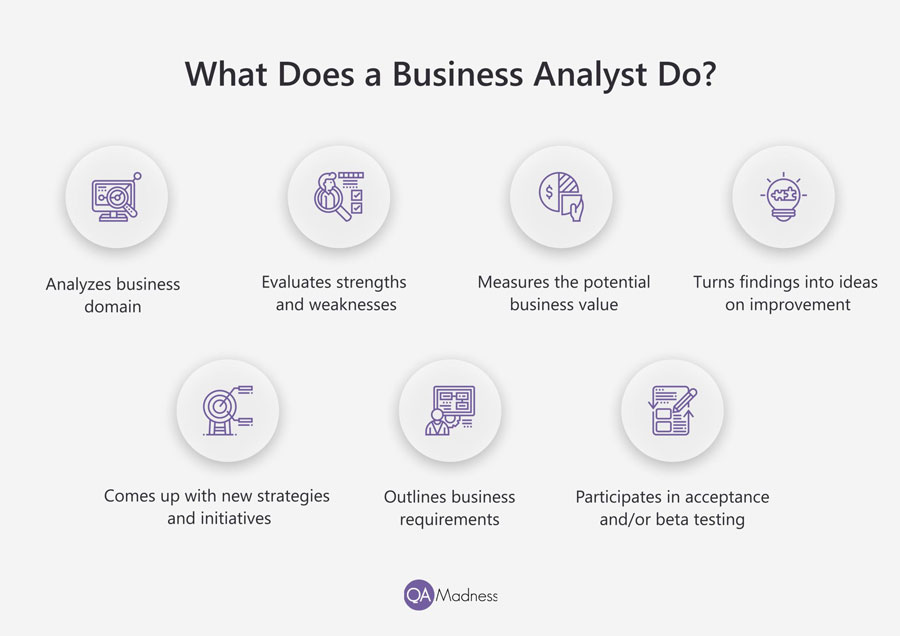
A QA Business Analyst is a member of a product development team whose task is to bridge the gap between an IT team and a business team. Usually, this specialist:
Here’s a more illustrative explanation. Let’s say, there is a product owner – a person with a clear understanding of the business objectives and business value of a certain project. This person also has the approximate requirements outlined: software type, core features, maybe even a highlight. However, the exact plan of getting from point A, where they are now, to point B, which is product release, is not apparent. Very often, product owners are not good at the tech aspects of the implementation. Meanwhile, IT specialists tend to prioritize tech aspects before business objectives. That’s where a Business Analyst steps in to help both sides find common ground.
Business Analysts use data-driven insights to determine the requirements and/or cover the areas that can be improved to increase the delivered business value. They introduce the reports for stakeholders and come to the IT team to balance the approved ideas with what is technologically feasible. It can also be the opposite process: a BA specialist analyzes whether feasible ideas are financially reasonable, blend with other functional and UX aspects, etc.
A Business Analyst doesn’t necessarily have a tech background. As long as they can gather and process business data, turning the findings into ideas on improvement, a general understanding of how a system works will do just fine.
So what does a Business Analyst do specifically? The role and responsibilities of this professional usually account for the following tasks:
The mission of a BA specialist can end at this point. The implementation becomes the task for a development team. However, a Business Analyst can supervise the implementation as well.
As a rule, a company’s practices and processes determine the scope of responsibilities for a Business Analyst. In other words, both parties should discuss the tasks and level of involvement before they start the cooperation.
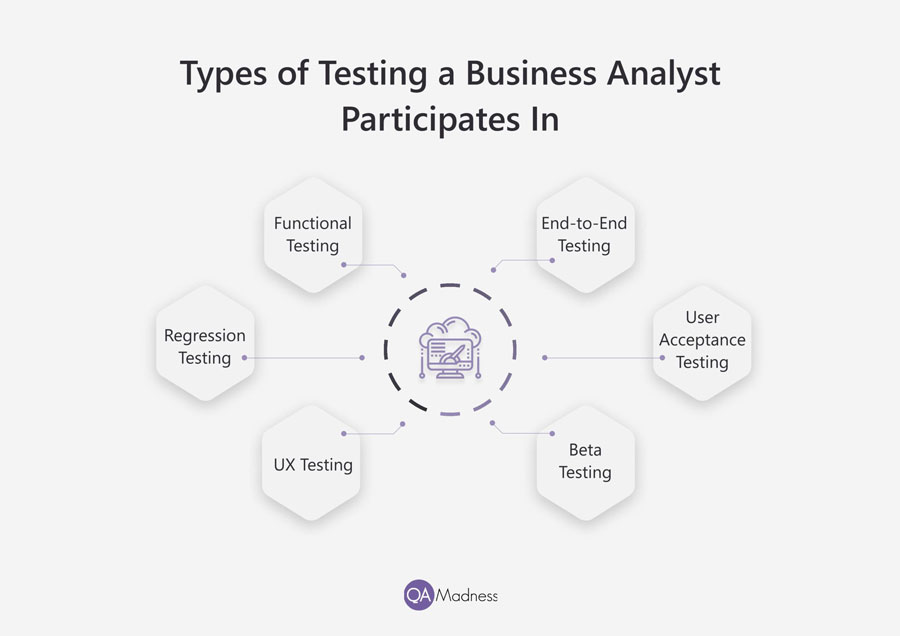
By the time testing starts, a Business Analyst completes studying and evaluating a company’s processes. There is already a plan for improvements, and a testing team sticks to it. So, a BA doesn’t run testing, but they can participate in preparing test cases.
For example, a BA specialist can check if the tests are written in conformance with the requirements. A Business Analyst can also be on the list of people authorized to sign a testing plan. For example, they can check the coverage and match scenarios with user stories before approval.
On the one hand, it is obvious for QA Engineers that they should address the requirements to create test cases. That’s the only way to make sure that the system performs as specified. Therefore, it is not a BA’s task to check if a certain testing activity complies with the requirements. On the other hand, a business perspective can alter the priorities a bit. It means that a Business Analyst can be the one to prioritize certain requirements and features in case of tight deadlines, lack of resources, or other issues.
A Business Analyst is a person QA Engineers can approach with questions at any stage of testing. As mentioned above, a BA doesn’t have to participate directly, but they can be a consultant, an advisor.
In 2026, the BA role has expanded alongside AI-assisted development. As teams adopt AI code generation and automated test suggestion tools, the BA becomes even more critical — someone needs to validate that AI-generated requirements and test scenarios actually reflect real business intent, not just technical completeness.
In case you are interested in career opportunities, here’s a piece of useful information. QA Engineers’ professional growth is marked by achieving certain QA grades as milestones. Eventually, a person can become a Senior QA Engineer, take a management position, or move in a bit of a different direction – business analysis, for example.
The good news is that QA Engineers make good BAs. Constant work with business requirements shapes a good understanding of product planning. Years of participation in testing activities build attention to detail and analytical skills. As a result, QA Engineers have both technical background and solid analytical skills.
Some companies don’t have a position of a Business Analyst. Nevertheless, someone needs to cover the BA responsibilities, at least partially. Developers and QA Engineers can come up with improvements on the way and offer new solutions. Product Owners can be in charge of requirements writing. So what makes a team realize that they need to involve a dedicated BA on the project?
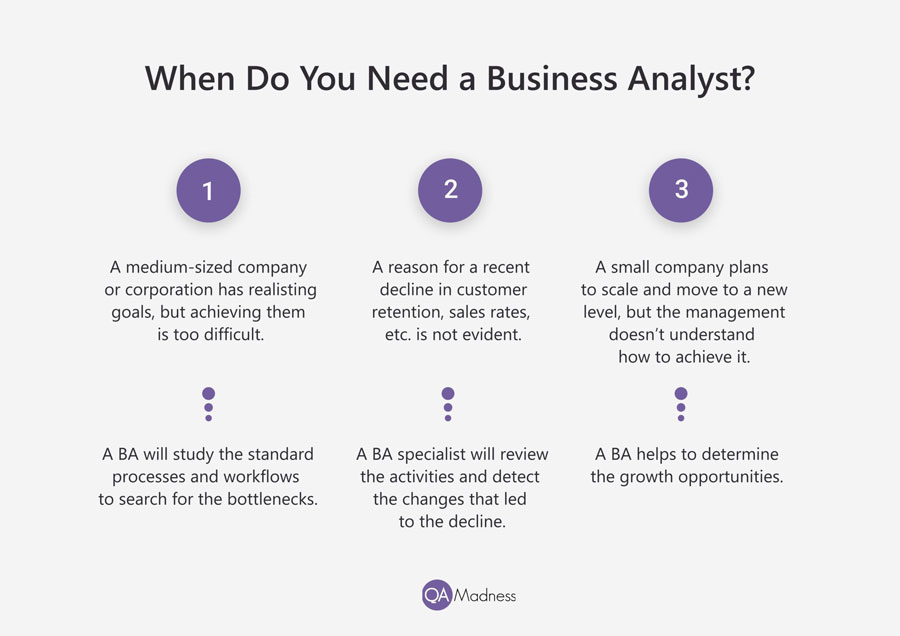
Every business is different, so the particular situations when you may need a BA specialist are different, too. We decided to unite the possible cases under three general categories.
In other words, a Business Analyst helps to find weak spots in the business processes and/or find an opportunity for business growth. If a company faces at least one of those needs, hiring a professional is a good idea.
A QA Business Analyst has a significant one to play in the development process. Low customer satisfaction is one of the many reasons why a business may need improvement. The changing technologies, outdated systems, inefficient processes are also tasks where a Business Analyst initiates the change.
A BA professional helps to see a company’s processes in detail – with all the highlights and flaws – and suggests the way for improvement. At the same time, they are able to see a bigger picture and advise on specific steps to take to reach the ambitious business goals.
A Business Analyst doesn’t always participate in testing directly. However, they can contribute to an efficient testing strategy and help a QA team to understand business priorities better. That’s why outsourced software companies often include BA on the list of services they provide. If your business has hidden potential or lacks efficiency — or if your team is scaling with AI tools and needs someone to keep business logic intact — a dedicated BA specialist is worth considering.
Not directly. A BA contributes to the testing process by writing or reviewing requirements, helping prioritize test cases, and participating in UAT and beta testing. The actual test execution is the responsibility of QA engineers.
A QA Engineer verifies that software works correctly from a technical standpoint. A Business Analyst verifies that the software meets business requirements and delivers the expected value. Both roles are complementary — QA engineers test how the software behaves, BAs ensure it solves the right problem.
Yes, and it is a natural career path. QA engineers develop strong analytical skills and deep familiarity with business requirements over time. Senior QA engineers often transition into BA roles because they already understand both the technical and business sides of a product.
A team needs a BA when processes are inefficient and the root cause is unclear, when customer satisfaction or retention is declining without an obvious reason, or when the company is scaling and needs structured guidance on priorities and requirements.
Not always. In small teams, the product owner or a senior developer often covers BA responsibilities informally. A dedicated BA becomes valuable when the product complexity or team size grows to the point where informal coverage creates gaps in requirements or testing priorities.
If you're leading a healthtech SaaS company, the question isn't whether to automate your QA.…
Last updated: June 16, 2026 A bug in an e-commerce app means a failed checkout.…
Last reviewed: June 2026 When an external audit is scheduled, most engineering teams do what…
Last updated: May 29, 2026 The average developer now ships 7,839 lines of code per…
Last updated: May 28, 2026 Choosing the wrong QA partner isn’t just a minor misstep…
In 2026, your website is your storefront, your sales rep, and your reputation – all…