This post is co-authored with Olha Hladka, a QA Engineer at QA Madness.
Today, we’d like to share some thoughts on the role of a QA Engineer in the team. It seems to be a simple subject to cover, but let’s try to dig deeper. Here are some questions we’re going to answer:
It’s time to find out the answers!
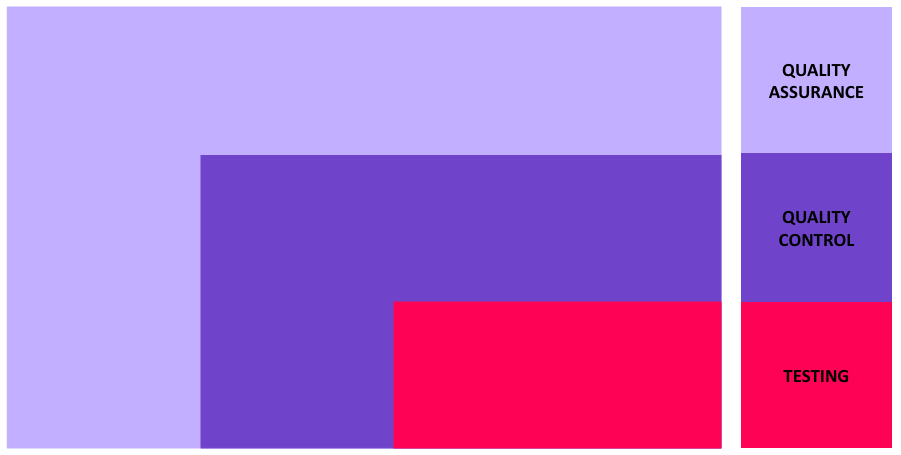
You might have already seen a well-known scheme that clearly shows the relations between these three positions – a Quality Assurance Engineer, a Quality Control Engineer, and a Tester. If you haven’t, take a look at the image below.
To be more specific:
This ‘classical’ division, however, is history now. You can still see QA and QC titles in QA Engineer job descriptions. But in terms of responsibilities, the distinction is a formality. And what about a ‘Tester’? To be honest, we can still use this title during informal conversations, but no more than that.
So there’s a logical question: do we still need this division? Theoretically, we can speak about varying responsibilities for these three job titles. In practice, though, a QA company prefers to nurture a one-man army whose skills and responsibilities won’t be limited to testing activities only.
Therefore, let’s further focus specifically on a QA Engineer role since it embraces the widest scope of tasks. It is also more common compared to the other two abovementioned roles.
We can state without a doubt that a QA Engineer should be a support, an anchorman for a development team. A QA Engineer is a person who can find the most vulnerable spots in any system and describe them correctly, present the results of their search, and get appreciation from the team. Developers can contact this specialist with any question or request regarding software testing services, and they will always receive assistance.
The duties of QA Engineers vary depending on a team size. For example, if a project team consists of only five people in total, a QA Engineer is the most likely to perform all the testing-related roles. This person will occasionally become a little bit of a Team Lead or an Analyst when needed. A QA Engineer will have a wide range of duties and tasks to cover. In particular, they have to make quality-related decisions at all stages.
So does it mean that being a part of a big team is a bad experience because a QA Engineer won’t be able to reveal various hidden talents? Well, both cases have their pros and cons. The obvious advantages of a big team are working hand in hand with seasoned professionals – colleagues who can share their experience and knowledge. It is also likely that a highly loaded project with so many people involved requires to divide the project into modules, forming smaller units that are easier to manage.
Probably, the correct answer to this question would be “it depends.” Yes, it all depends on the project. If the project is complex and a small team is working on it, then most likely, a Quality Assurance Engineer will need to be well-versed in testing. This team member is expected to know various technologies, apply diverse techniques, and cover different types of testing.
In big teams, the responsibilities, most likely, will be divided between specialists with the corresponding skills. Each person will be responsible for their own piece of functionality. Still, this is not bad since every person will be a professional in their part of the functionality.
It is simple to get lost, trying to figure out the QA roles and responsibilities. In this post, we’ll go with job duties for QA Engineers only. There are Junior, Middle, and Senior QA Engineers, and QA Leads/Managers. Each position differs from the rest primarily by the areas of responsibility involved.
A Junior QA Engineer gets tasks explained in detail, can feel free to ask many questions, and ask colleagues for help with some tasks. This person works on simple assignments, for complicated tasks are not within a Junior QA Engineer’s area of proficiency. Their work is supervised, and the results always undergo a check by another team member.
A Middle QA Engineer’s responsibilities are more diverse as these specialists already have some basic knowledge and experience in testing. Middle QA Engineers can work independently and efficiently on complex tasks. They can also mentor Junior teammates, supervise or help them with work. But when in doubt or working on complicated tasks, they are free to ask for consultation by a Lead or other colleagues.
Just like Juniors, Middle QA Engineers need to receive feedback from technical specialists with detailed answers and explanations. It helps them to become better specialists and proceed with further training.
A Senior QA Engineer works independently on complex tasks, helps junior colleagues, independently evaluates the situation, prioritizes tasks, plans and delegates their implementation. It is a person other people listen to and reach out to for arguments to defend their point of view.
This is the one true level of expertise 😉 QA Leads and QA Managers confidently govern a team of QA engineers (and sometimes developers!). Some members of the team need guidance, and some don’t. The head specialist participates in the most complicated tasks. Thus, a list of QA Manager or QA Lead responsibilities can feature the selection of a technology stack, architecture, team formation, long-term planning, risk assessment, etc.
In conclusion, we’d want to remind you that a QA Engineer plays a significant role in a team. Regardless of their grade and level of experience, QA Engineers focus on debugging the mechanisms of program operation in manual or automatic mode. They carefully inspect software products to find all the bugs, issues, and defects. And they know the nuances in the difference between all these terms! That’s the role of a QA Engineer, and this role is very significant at every stage of the development process.
Last updated: May 29, 2026 The average developer now ships 7,839 lines of code per…
Last updated: May 28, 2026 Choosing the wrong QA partner isn’t just a minor misstep…
In 2026, your website is your storefront, your sales rep, and your reputation – all…
If you are running a digital business in 2026, you’ve likely heard that automation is…
With the sharp shift in how cyber resilience is approached and the EU’s CRA introducing…
From the start, automated testing services have been hailed as the best invention since sliced…