QA MadnessBlog How to Choose a QA Partner for a FinTech Product
How to Choose a QA Partner for a FinTech Product
Reading Time: 12minutes
Last updated: August 7, 2026
Choosing a QA partner for a FinTech product is not the same as choosing one for a SaaS dashboard or a content platform. The stakes are different. A missed bug in a payment flow does not produce a broken UI; it produces a failed transaction, a compliance incident, or a data breach. The wrong vendor will slow you down, expose you to regulatory risk, and leave your engineering team managing testers instead of building. The right one functions as a quality owner embedded in your SDLC – not just a team that runs test cases at the end of a sprint.
This guide gives you a structured framework to evaluate QA vendors before you sign anything. It covers the seven criteria that matter most in FinTech QA, how to compare engagement models, what to ask on a discovery call, and the warning signs that tell you to walk away.
Who this is for: CTOs, VPs of Engineering, and CEOs at FinTech companies evaluating external QA partners for payment platforms, lending products, KYC/AML flows, or other regulated financial software.
Most software products can tolerate a degree of imperfection at launch. FinTech products cannot. The combination of financial data sensitivity, real-money transaction flows, and regulatory obligations means that QA gaps translate directly into business risk.
The three dimensions that make FinTech QA distinct
Regulatory exposure. Depending on your market and product type, you may operate under PCI DSS (payment card data), PSD2 (open banking, EU), GDPR (personal data), AML/KYC requirements, or SOC 2 (security controls). A QA partner who does not understand these frameworks cannot test for compliance gaps. They can only test for functional correctness, which is necessary but not sufficient.
Transaction integrity. Financial calculations must be exact. Rounding errors, currency conversion issues, settlement discrepancies, and reconciliation failures are not cosmetic bugs. They are financial liabilities. Testing payment flows, ledger entries, and balance calculations requires domain knowledge that generic QA teams often lack.
Security and data handling. Any vendor with access to your test environment is handling sensitive data. They need documented security protocols, NDAs aligned to your compliance obligations, and clear data handling agreements. A vendor who cannot describe their test data management process is a compliance risk before they write a single test case.
These three dimensions are why evaluating a FinTech QA partner requires a different checklist than evaluating a general software testing vendor.
7 Criteria for Evaluating a FinTech QA Partner
Use this table as your primary evaluation scorecard. Each criterion is weighted by its relative importance in a FinTech context. The weight reflects how much that factor should influence your final decision, not just whether a vendor meets a baseline.
Criterion
Why It Matters
What to Look For
Red Flag
FinTech Domain Experience (25%)
Generic testing experience does not transfer to payment flows, KYC validation, or compliance-related edge cases. The ramp-up cost is real and paid in missed bugs.
Verifiable case studies involving payment systems, lending, KYC/AML, or open banking. Named clients or anonymized but specific outcomes.
“We work across all industries” with no FinTech-specific case study or reference.
Regulatory and Compliance Knowledge (20%)
Your QA partner needs to understand what they are testing for, not just how to execute test cases. Compliance gaps are invisible to testers who do not know the regulations.
Team familiarity with PCI DSS, PSD2, GDPR, SOC 2, or AML/KYC as applicable to your product. Ask for specific examples of compliance-related test scenarios they have built.
Cannot explain how their test coverage maps to your regulatory obligations. Treats compliance as a checkbox rather than a risk-driven activity.
Security Protocols and Data Handling (15%)
Any vendor accessing your test environment is handling financial and personal data. Weak data controls are a direct compliance liability for you.
ISO/IEC 27001 certification or equivalent. Documented NDA and data handling procedures. Clear policy on test data generation (synthetic vs. anonymized production data).
No documented security framework. Vague answers about how they handle PII or financial test data. Unwillingness to sign an NDA before discussing project details.
Test Environment Readiness (15%)
FinTech vendors work with sandboxes, staging environments, and payment processor simulators. A partner who cannot operate within your environment setup will slow every sprint. Production testing policy matters too: some FinTech teams run smoke tests on prod, and your vendor needs a clear, documented stance on this.
Proven experience with sandbox environments (Stripe, Adyen, open banking APIs). Documented test data management: synthetic data generation or anonymized data. Explicit policy on production testing scope and associated risk controls.
No experience with payment sandbox environments. Vague answers about test data origin. No defined policy on production testing.
Technical Breadth in FinTech-Relevant Testing (10%)
FinTech products require more than functional testing. Security, performance under load, API integration testing, and automated regression coverage are not optional. Manual-only vendors cannot scale with your release cadence.
Demonstrated capability in security testing, performance/load testing, and API testing. Evidence of test automation for regression coverage on payment flows and critical user journeys. Ask specifically which frameworks they use (Playwright, Selenium, Cypress) and how automation fits into your CI/CD pipeline.
Only offers manual functional testing. No automation capability or experience with CI/CD integration. Cannot demonstrate automated coverage on payment flows or API integrations.
Delivery Speed and Onboarding (10%)
A partner who takes four weeks to ramp up costs you sprint cycles. FinTech teams move fast and need QA that integrates quickly.
Documented onboarding process. Ability to start within 1-2 weeks. QA Lead provided by the vendor (you should not need to manage individual testers).
No clear onboarding timeline. Requires you to write all test cases before they can start. Needs significant hand-holding from your engineering team.
Communication and Reporting Quality (3%)
QA findings are only useful if they are communicated clearly. Defect reports that do not explain business impact waste engineering time.
Clear defect reporting with severity, reproduction steps, and business context. Willingness to give a go/no-go recommendation, not just a list of open issues.
Defect reports are formatted as ticket dumps with no prioritization. Team avoids giving direct opinions on release readiness.
Engagement Flexibility and Scalability (2%)
FinTech product roadmaps change. You need a partner who can scale up before a major release and scale down between cycles without contract renegotiation.
Flexible engagement models (hourly/T&M and dedicated team options). Track record of scaling teams up or down based on client needs.
Rigid minimum commitments that do not align to your release cadence. No mechanism to add or reduce capacity mid-engagement.
Scoring tip: Rate each vendor 1-5 on each criterion, then multiply by the weight percentage. Total scores above 80/100 indicate a strong match; below 60/100 suggests a poor fit regardless of price.
A note on AI-assisted QA
Some vendors now offer AI-assisted QA workflows, where AI tools accelerate test generation, regression execution, and anomaly detection. This can meaningfully speed up delivery cycles on high-volume FinTech products. That said, AI accelerates the work; it does not replace QA ownership. The QA engineer remains responsible for coverage decisions, risk assessment, and release readiness. When evaluating a vendor’s AI capability, ask specifically how their engineers use AI tools and what decisions remain with the human team.
Hourly vs. Dedicated Team: Which Engagement Model Fits Your Product?
Once you have identified a shortlist of qualified vendors, the next decision is how you want to structure the engagement. The two most common models are hourly (time and materials) and dedicated team. Each has a different cost structure, knowledge-retention profile, and fit for different stages of product development.
Parameter
Hourly / Time & Materials
Dedicated Team
Pricing structure
Billed per hour worked. Rates typically range from $25-$100+/hour depending on vendor location, seniority, and specialization.
Fixed monthly cost based on team composition. Predictable budget line.
Minimum commitment
None or low (often per-sprint or per-engagement). Suitable for one-off testing cycles or pre-release sprints.
Typically 3-6 months minimum. Structured for ongoing product development.
Domain knowledge retention
Low to medium. If testers rotate between projects, institutional knowledge of your product is lost between engagements.
High. The same team works on your product continuously, building deep familiarity with your payment flows, edge cases, and regulatory context.
Budget predictability
Variable. Costs fluctuate with testing demand and sprint scope. Can be difficult to forecast across quarters.
Fixed monthly cost makes QA a predictable budget line. Easier to justify to finance and investors.
Best fit for
Pre-release testing sprints, one-time QA audits, augmenting an existing in-house QA team, or validating a specific feature before launch.
Continuous-release products, teams without in-house QA, regulated products requiring consistent test coverage and audit trails across release cycles.
Scaling flexibility
High. You can increase or decrease hours based on sprint demand without structural changes.
Medium. Scaling requires adding or removing team members, which involves a short ramp-up period.
Which model is right for a FinTech product?
For most FinTech products in active development, a dedicated team model is the stronger choice. Regulated environments benefit from consistency: the same engineers who tested the previous release understand the compliance context, know the edge cases in your payment flows, and can maintain audit-ready documentation across release cycles.
Hourly engagements make sense when you need a specific, bounded deliverable: a QA audit before a compliance review, a security testing sprint before a PCI DSS assessment, or regression coverage for a specific feature release. They also work well as a low-commitment way to evaluate a vendor before moving to a longer engagement.
Many FinTech teams start with an hourly engagement for an initial QA audit, then transition to a dedicated team once they have validated the vendor’s domain knowledge and delivery quality.
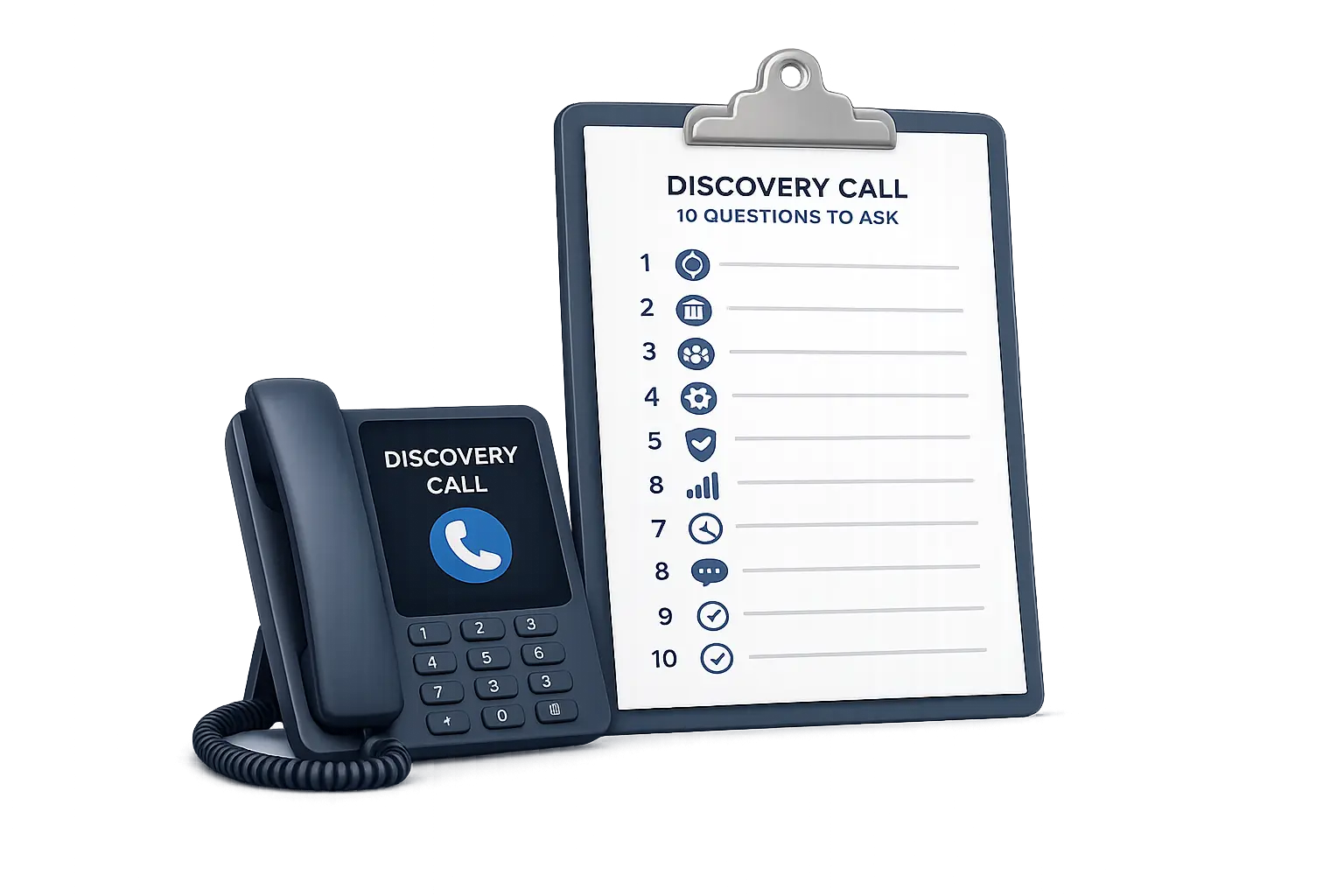
10 Questions to Ask on a Discovery Call
A discovery call is not a formality. It is your primary tool for verifying claims made on a vendor’s website and for surfacing gaps they would prefer you not notice. These ten questions are designed to reveal domain depth, process maturity, and how the vendor actually operates, not how they present themselves.
Ask every vendor the same questions in the same order. Consistency makes comparison easier and prevents a persuasive sales conversation from substituting for evidence.
Questions about domain knowledge and experience
1. Can you walk me through a FinTech project you have completed, including what you tested and what you found?
A strong answer includes the product type (payments, lending, KYC), the testing scope (functional, security, performance), specific defects or compliance gaps discovered, and the outcome. A weak answer is generic or pivots to capabilities rather than outcomes.
2. Which regulations are relevant to our product type, and how have you tested against them in previous engagements?
You are testing whether they understand PCI DSS, PSD2, GDPR, or AML/KYC as applicable to your context. The answer should be specific. “We have experience with compliance testing” is not an answer.
3. How do you handle test data that contains or resembles financial or personal data?
This question surfaces data handling maturity. A qualified vendor will describe their approach to synthetic data generation, data masking, or anonymization. They will also reference their NDA and security framework without being prompted.
Questions about technical capability
4. What does your approach to automated testing look like for a product like ours, and which frameworks do you use?
For FinTech products with frequent releases, automated regression testing for payment flows is not optional. The answer should reference specific frameworks (Playwright, Selenium, Cypress, or similar) and describe how automation fits into the CI/CD pipeline.
5. How do you approach security testing for financial applications? Do you have an in-house capability or do you partner for this?
Security testing for FinTech is specialized. A vendor may have in-house capability or work with a dedicated cybersecurity partner. Either is acceptable; what matters is that they have a defined approach and can describe it concretely.
6. How do you test API integrations, particularly between payment processors, banking APIs, or third-party financial data providers?
FinTech products are integration-heavy. API testing depth is a strong signal of domain maturity. Ask for a specific example.
7. How do you manage sandbox environments, test data, and production testing boundaries for FinTech products?
This question reveals environment maturity in one go. A qualified vendor will describe their experience with payment sandbox environments (Stripe, Adyen, open banking APIs), explain how they handle test data (synthetic generation or anonymized production data), and have a documented, explicit policy on what testing, if any, they run in production and what risk controls apply. Vague answers here are a direct compliance risk.
Questions about process and delivery
8. What does your onboarding process look like, and how quickly can your team be productive on our codebase?
A well-run QA vendor has a documented onboarding process. Expect 1-2 weeks for a dedicated team to reach full productivity. If the answer is vague or depends entirely on your team’s availability to train them, that is a process maturity gap.
9. Who specifically would work on our project, and what is their FinTech experience?
You are hiring engineers, not a company. Ask to see the profiles of the QA Lead and engineers who would be assigned to your project. If the vendor cannot answer this before the contract is signed, you may receive a team that does not match what was sold.
10. What does a go/no-go recommendation look like from your team before a release?
A mature QA partner does not just deliver a list of open bugs. They provide a release readiness assessment: which defects are blockers, which are acceptable risks, and a clear recommendation. If the vendor avoids giving direct opinions on release readiness, that is a signal worth noting.
Red Flags Checklist: When to Walk Away
No vendor presents their weaknesses voluntarily. These seven red flags are the ones most likely to surface during a discovery call or early engagement, and each one represents a specific category of risk for a FinTech product.
Use this as a final filter after scoring vendors against the seven criteria above.
➛ No FinTech-specific case study or reference. If a vendor cannot point to a verifiable project involving payment systems, KYC flows, lending products, or financial data, they are learning on your product. In a regulated environment, that learning cost is yours to absorb.
➛ Vague or evasive answers about regulatory knowledge. A vendor who responds to questions about PCI DSS or PSD2 with “we adapt to each client’s requirements” is telling you they do not have the knowledge. Compliance testing requires specific expertise, not adaptability.
➛ No documented security framework or ISO certification. Handling financial test data without a documented security framework is a compliance liability. ISO/IEC 27001 certification is a reasonable baseline expectation for any vendor working with regulated industries. Its absence does not automatically disqualify a vendor, but it requires deeper scrutiny of their data handling practices.
➛ Cannot name the engineers who would work on your project. If the vendor cannot tell you who would be on your team before the contract is signed, you are buying a brand, not a team. In QA, the individual engineers matter. Seniority, domain experience, and communication quality vary significantly within any vendor organization.
➛ Only offers manual testing with no automation capability. FinTech products release frequently. Without automated regression coverage on payment flows and critical user journeys, every release requires a full manual regression cycle. That is slow, expensive, and error-prone. A vendor without automation capability is not a scalable partner.
➛ Unwillingness to provide a sample defect report or test summary. Transparency about how they communicate findings is a basic ask. A vendor who declines to share a sample report (even anonymized) is either hiding poor-quality output or lacks the documentation maturity to produce one.
➛ Pressure to sign quickly or skip a POC engagement. A confident, capable vendor welcomes scrutiny. High-pressure sales tactics or resistance to a bounded proof-of-concept engagement before a long-term contract are signals that the vendor knows a closer look will reveal gaps. A QA audit or a single-sprint engagement is a standard, low-risk way to validate a vendor before committing. Resistance to this is a meaningful warning sign.
How to Structure Your Vendor Evaluation Process
The criteria, questions, and red flags above are most useful when applied within a structured process. Ad hoc vendor evaluation produces inconsistent comparisons and decisions driven by the last sales conversation rather than evidence.
A practical four-step evaluation process
Step 1: Build your shortlist (1-2 days)
Start with vendors who have documented FinTech experience. Review published case studies, check ratings on Clutch and G2, and ask your network for referrals. Aim for 3-5 vendors who pass the basic FinTech domain filter before scheduling any calls.
Step 2: Run structured discovery calls (1 week)
Use the ten questions above with every vendor on your shortlist. Take notes in a consistent format. Ask for sample deliverables (defect reports, test plans, or case studies) before the call ends. Do not make a decision based on the call alone.
Step 3: Score against the seven criteria (1-2 days)
After each call, score the vendor against the seven criteria table. Use the 1-5 scoring approach with the weighted percentages. This converts subjective impressions into a comparable number.
Step 4: Validate with a POC engagement
Before committing to a long-term contract, run a bounded proof-of-concept: a QA audit, a single-sprint engagement, or a security testing review. A POC gives you concrete evidence of delivery quality, communication style, and domain knowledge that no sales conversation can replicate. It also gives the vendor a chance to demonstrate their value before you make a significant commitment.
Review QA Madness case studies for examples of how a structured QA engagement typically unfolds across different product types and stages.
Summary
Choosing the wrong QA partner for a FinTech product is not just an operational inconvenience. It is a risk event. Missed compliance gaps, weak data handling, and inadequate security testing coverage can surface as regulatory findings, customer-facing failures, or security incidents.
The framework in this guide gives you a repeatable process to avoid that outcome:
1. Score vendors against seven weighted criteria, with domain experience and regulatory knowledge carrying the most weight.
2. Choose an engagement model that fits your release cadence: dedicated team for continuous development, hourly for bounded deliverables.
3. Ask the same ten discovery call questions to every vendor to enable consistent comparison.
4. Apply the red flags checklist as a final filter before shortlisting.
5. Validate with a POC before committing to a long-term contract.
A well-chosen QA partner does not just find bugs. They own quality across the entire development cycle – from requirements review and risk analysis through test execution and release readiness. They understand the regulatory context your product operates in, integrate with your engineering team without needing micromanagement, and give you the confidence to release without second-guessing your coverage. That last point matters more than it sounds: a team staffed entirely with Middle and Senior QA engineers brings the domain judgment to make independent decisions, not just execute test cases.
Next steps: If you are not yet certain what your FinTech product requires from a QA perspective, the FinTech Software Testing: Complete Guide for 2026 covers testing types, compliance considerations, and QA strategy in detail. If you are ready to evaluate vendors, a QA audit is the lowest-risk starting point: it produces a concrete deliverable and gives you direct evidence of how a partner thinks about your product before any long-term commitment.
FAQ
What should FinTech companies look for in a QA partner?
FinTech companies should look for proven domain experience, regulatory awareness, security discipline, strong technical testing capability, and a clear discovery process. The best partner can explain how they test payment flows, handle sensitive data, and support release readiness without relying on generic claims.
When is a dedicated QA team better than hourly support?
A dedicated QA team is usually better for products in active development because the same people retain domain knowledge and maintain consistent coverage across releases. Hourly support works better for bounded work, such as a QA audit, a POC, or a specific sprint.
What are the biggest red flags when choosing a FinTech QA vendor?
The biggest red flags are vague answers about regulations, no FinTech case studies, weak data handling, only manual testing, no sample reports, pressure to sign quickly, and no clear team assigned before the contract starts.
Why is a QA audit a good starting point?
A QA audit is a low-risk way to validate a vendor before a longer engagement. It shows how the partner thinks about your product, what they find, and how clearly they communicate findings before you commit to a dedicated team.
FinTech is one of the most demanding software environments. Money moves in real time, regulators watch closely, and a single defect can trigger financial loss, a compliance penalty, and a public trust problem in the same afternoon. The global FinTech market is already valued at roughly $394.88 billion in 2025 and climbing fast, according to Fortune Business Insights. That growth means more products, more integrations, and more attack surface, which is precisely why quality assurance has moved from an engineering detail to a board-level concern. This guide is written for CTOs and heads of engineering at B2B FinTech companies with $5M–$50M in ARR across the US, UK, and Germany. You are past the prototype stage. You have real customers, real transaction volume, and real regulatory exposure. The question is no longer whether to invest in testing, but how to do it deliberately. We will cover why FinTech QA differs from standard testing; what GDPR, PCI DSS, and SOC 2 actually require of y...
Most engineering leaders don't outsource QA because they planned to. They outsource because a release slipped, the hiring pipeline stalled, or the team simply doesn't have QA coverage at all. By that point, the decision is reactive rather than strategic - and reactive decisions cost more. But there are equally valid reasons to outsource from the start: you need a team that already has QA processes in place, you want to scale testing capacity quickly without building a department, you're looking for access to diverse devices and platforms your in-house team doesn't have, or you need short-term coverage without a long-term headcount commitment. Sometimes it's simpler than that - you don't have a recruitment team, and hiring QA engineers takes months you don't have. This guide is built for CTOs, Heads of Engineering, and Product leaders who want to make this decision strategically, not under pressure. It covers the four decisions that actually matter: whether to outsource at all, wh...
Last Updated: June 2026 A dedicated QA team is a team of quality assurance specialists who work exclusively on a single product or project. Unlike developers who split their focus between coding and testing, dedicated QA professionals concentrate entirely on identifying defects, improving software quality, and ensuring a reliable user experience through functional, regression, performance, and compatibility testing. Testing is irreplaceable. And the way you approach it is everything. From the Therac-25 disaster to Boeing 737 Max crashes – you know that quality assurance can make or break your business. Hence, for your product to be superior, you need a QA team that can support your vision. What kind of a team it should be? Let’s find out. Dedicated QA Team vs Dedicated Testing Team: What's the Difference? The terms "dedicated QA team" and "dedicated testing team" are often used interchangeably - but they don't mean exactly the same thing. A dedicated testing team focuses prim...
Last updated: July 28, 2026 Poor software quality is expensive. CISQ estimates that poor software quality cost the U.S. economy $2.41 trillion in 2022, with $1.52 trillion tied to operational failures and technical debt. At the team level, hidden quality costs can reach $55,000 to $78,000 per developer per year. But not every quality-related engagement should start with the same framing. When companies look for QA consulting, they are not always trying to investigate what is broken. Often, they already know what they want to do. They want to build a QA function from scratch. Replace fragmented testing practices with a unified process. Introduce automation into a manual-heavy workflow. Expand quality operations to support faster releases, a larger product, or a more complex engineering team. That is where QA consulting should be positioned clearly. A QA audit is primarily about diagnosing quality gaps, delivery risks, and their root causes. QA consulting goes further. It ...
Last updated: August 6, 2026 Most teams that struggle with QA automation do not have a tooling problem. They have a vendor problem. They hired a provider that can produce test scripts, but cannot explain what those tests protect, cannot connect coverage to business risk, and cannot keep the system maintainable as the product evolves. The market has moved. According to the 2025-2026 State of Testing report by PractiTest, AI adoption is now common in QA workflows. That raises the baseline. If a provider still treats automation as a collection of scripts instead of an engineering system, they are behind the market. This article focuses specifically on web automation for teams building automation from scratch or near-scratch. Mobile automation is a related track but requires a separate tooling discussion. And if your project already has an existing automation suite you want to hand off to an outsourced team, that scenario deserves its own evaluation framework, since the priorities...
Choosing a QA partner for a B2B SaaS product is not a procurement exercise. It's an engineering decision that directly affects your release velocity, your bug escape rate, and ultimately your customer retention. Yet most "best QA companies" lists rank vendors by marketing spend, company size, or how many awards they've collected. None of those tell you whether the team will write actionable bug reports, integrate into your Scrum ceremonies, or hold up under sprint pressure. This article takes a different approach. We evaluated companies on criteria that actually predict delivery quality: SaaS domain expertise, testing depth, automation maturity, Agile compatibility, team structure, pricing transparency, and verified client outcomes. The result is a ranking you can use to make a real decision, not just a shortlist of names you've already heard. Who this is for: CTOs, VP Engineering, Engineering Managers, Product Managers, and Heads of QA at B2B SaaS companies looking for an ext...