What is Black Box Testing and How Does it Help Your Business?
As the name suggests, black box testing means running a quality check without knowing the internal architecture or having access to the code. A QA specialist doesn’t need this info. Instead of looking at backend technologies, they focus on the requirements described in your technical documentation.
This method is the backbone of manual software testing and mobile app testing. It allows a quality assurance & testing company to check the final product exactly as your users will see it. Since it perfectly suits large code elements, it is a staple in high-level system and acceptance testing. When you QA outsource to an external team, they use this to ensure that every button and form works exactly as your customers expect.
What is White Box Testing and Why is it Part of a Modern Strategy?
White box testing is the polar opposite. It implies that a QA engineer or developer knows the software architecture and understands the code powering every feature. This deep access allows the team to use the code itself as an additional source of information to find bugs that are hidden deep in the logic.
In 2026, this is where test automation services truly shine. By looking into the code, a specialist can check separate branches or paths to find defects before they ever reach the user. This is highly effective for automating regression testing at the unit and integration levels. Many successful firms use QA outsourcing to gain access to senior engineers who can perform these deep-dive checks.
What is Gray Box Testing and When Should You Use It?
Gray box testing is the hybrid “sweet spot.” It involves a combination of both methods, meaning the QA resources have partial knowledge of the product code. While the unique aspects remain a secret, this limited access is incredibly helpful when looking for context-specific errors. Many businesses use this for outsourced software testing to balance technical depth with user-facing validation.
What are the Main Differences Between Black Box and White Box Testing?
Choosing the right software testing outsourcing model requires understanding the fundamental differences in how these tests are performed.
The black box testing suits perfectly for large code elements. Test cases are usually very detailed and specific about entry conditions, test steps, planned results, and test data. As for the white box testing, it is an effective solution that gives a technical opportunity to find and fix code lines with defects. Test cases focus on technical details and code particularities.
The fundamental difference between the two types of testing is clear, but let’s look into the details and compare black box and white box testing.
| Criteria |
Black Box |
White Box |
Gray Box |
| Code access |
No |
Full |
Partial |
| Who performs |
QA engineers |
Developers / senior QA |
QA engineers |
| Focus |
User-facing behavior |
Internal logic, code paths |
Context-specific errors |
| Best for |
System, acceptance testing |
Unit, integration testing |
Integration, security testing |
| Test cases based on |
Requirements, specs |
Code structure |
Partial specs + code |
| Automation fit |
Medium |
High |
Medium |
| When to use |
Final stages, UAT |
Early dev, regression |
When partial access available |
Do You Have Real-World Examples of These Testing Methods?
Quick answer – yes. Let’s look at a registration process to see how these methods differ in real-time.
- Black Box Testing Example: A QA specialist checks if a user can register by entering a valid email and password. They verify that a success message appears. They don’t need to see the code; they only see the result on the screen.
- White Box Testing Example: A specialist inspects the actual code executing that registration. They check the backend logic to ensure the system correctly handles cases where an email already exists in the database. They test the decision statements and loops to ensure there is no “silence” or backend system crash if a requirement isn’t met.
Black Box Testing Examples
During the black box testing, a QA engineer checks different inputs and outputs to make sure they match. Explained simply, a user can register in a system only if they enter a valid username and password. Therefore, a QA specialist needs to learn what ‘valid’ is for the product. After that, it is necessary to check how the system responds to both valid and invalid inputs.
For example:
- A user can register in the application if they enter a phone number in a required format or an email address without obvious mistakes (like @ missing) and a password that has at least one capital letter, one digit, and one symbol.
- If at least one of the requirements isn’t met, a corresponding error message appears on the screen, signaling that there is a mistake.
- An error message should be clear (verbal explanation instead of numerical error code) and highlighted (appear in a different color to attract attention).
It is essential to check the scenarios where a system can break. This is how we learn whether the software product responds to failing scenarios as expected. Invalid inputs can cause just inconveniences (an error message doesn’t appear on the screen) or cause app crashes.
For all these scenarios, a QA engineer doesn’t need to address software architecture or look into the code. They can see if the features work as expected without it. Thus, the backend stays locked in a box while we run tests on the surface.
White Box Testing Examples
During white box testing, you look into software code to check its logic. The coverage can differ – testing can cover separate statements, branches, or complete paths. As code syntax varies depending on a programming language, let’s take a look at the graphic representation of a registration path.
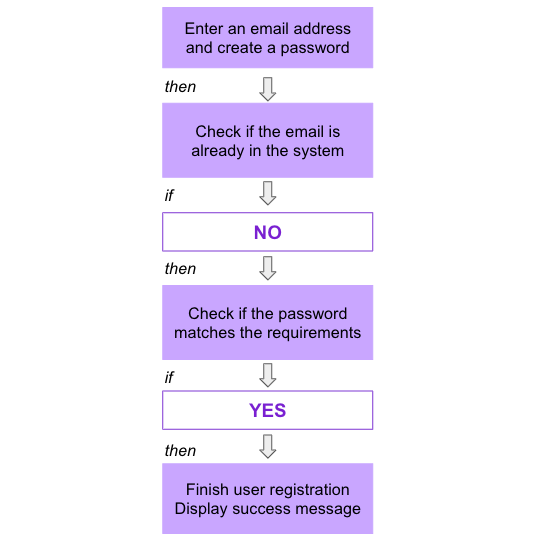
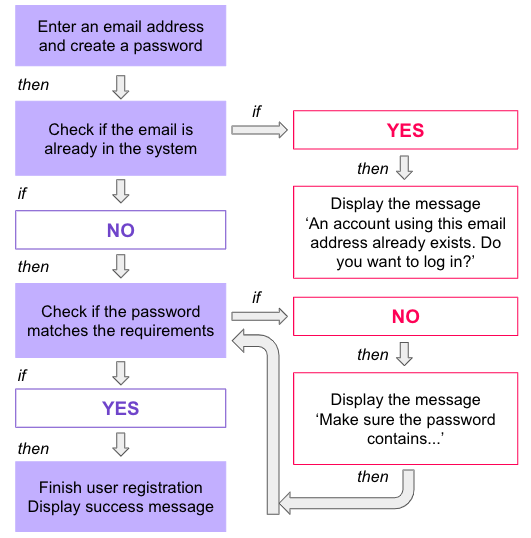
By inspecting a piece of code executing this path, a specialist can check the scenario of successful registration. However, it is not sufficient. What if a user has already registered in the system long ago and forgot about it? What if the password doesn’t meet the security criteria?
It is crucial to cover different scenarios on the backend – to have a piece of code for each. Otherwise, if a user cannot proceed with the registration, instead of tips and directions there will be silence. Therefore, it is necessary to test more complicated code snippets with decision statements and loop statements.
Why Should Your Team Perform Both Types of Testing?
You cannot substitute one for the other. Both are essential for achieving a high-quality product and have a specific place in your pipeline.
Used in combination, they help you achieve maximum bug elimination. According to research from Polaris Market Research 2026-2034, the demand for integrated outsourced testing workflows is growing as companies strive for continuous delivery.
By combining automated testing services (White Box) with strategic manual software testing (Black Box), you ensure that your code is clean and your user experience is perfect. McKinsey notes that high-maturity QA practices like these are a key driver of developer velocity and overall business growth.
To Sum Up: Which One to Perform?
You cannot substitute white box testing for black box testing or vice versa. Both are essential for achieving the goal of the software testing process. Both have a specific purpose and place in the software development pipeline.
Used in combination, white box and black box testing enhance the QA check. They help to achieve maximum bug elimination, detecting defects through both interaction with software and discovering the root causes of those defects.
FAQ
What is the best type of testing for mobile app testing?
A black box is essential to see how the app feels, but a white box (unit testing) is needed to ensure the app is stable across different devices.
Can we rely solely on outsourced QA?
Yes, if you partner with a reputable software testing company. They can provide a dedicated QA team that handles everything from initial manual checks to complex automating regression testing.
How do I decide what types of testing can be automated?
Refer to a proven test automation strategy to see which repetitive black box tests and deep-dive white box tests will give you the highest ROI.
Is gray box testing more expensive?
Not necessarily. It often saves money by finding bugs earlier that would be much more expensive to fix if discovered only during the final acceptance phase.
Ready to modernize your QA?
Whether you need deep-dive white box audits or comprehensive black box QA services, we can help you build the “safety net” your product deserves.